
Many of the aspects of online marketing for healthcare providers have a plethora of focus on the same type of generic advice.
Searching various platforms reveals that marketing agencies favour high-budget retainers while concealing actual cost per lead numbers and performance figures from practices.
Marketing agencies advise practices to "be authentic" and "post consistently", but provide no guidance on what the lowest budget should be, what the constraints of each platform are, or what segments of their business are impacted by compliance.
Local Dental Clinics with a very tight operating margin cannot afford to lose thousands of dollars testing vague concepts.
They need precise data on what friction points exist, what platform limitations exist, and how long it takes from when potential clients view video content to when they are seated in the dental chair.
Using available data and examining the current marketplace for dental clinics, as well as historic trends that will shape the future of dental clinic marketing strategies, we have developed a step-by-step plan to run low-cost, high-converting TikTok campaigns.
Key takeaways on current state of the market for healthcare providers on TikTok in 2026
As stated before, before discussing the mechanics of the TikTok platform, we first want to establish where the market is right now based on a 12-month view of the changes made by TikTok as it relates to social media for healthcare providers.
- Consistency is Key: The TikTok algorithm in 2026 systematically rewards TikTok accounts that show consistency in how they post. If your TikTok account posts consistently, you will generate higher-quality traffic than posting a single, viral hit. Post consistently two to three times per week with a moderate amount of engagement is better than posting a viral hit once.
- Advancements in Cost Cap: By using Smart+ Cost Cap alongside Messaging Ads, you will see reductions of up to 20% in your CPA due to this advertising method's success within localized clinics.
- Search Engine Optimization of TikTok Videos: Unlike previous years, TikTok videos now receive an enormous amount of indexed results from Google. The density of Keywords found within the captions of TikTok videos has a direct impact on searching for these videos across platforms.
- The "Intent" Myth: The belief that TikTok is strictly a "low intent" awareness channel is outdated. When properly structured through the use of a retargeting funnel, cosmetic dentistry campaigns are producing direct high-ticket conversions.
Why traditional advice fails dental practices
Traditional advice for marketing a dental practice falls into one of two general categories: superficial educational materials or overly optimized agency pages.
Neither helps out the local practitioner.
The agency trust gap
There is an inherent conflict of interest between agencies and dental practitioners.
Agencies do not publish exact prices for their services or step-by-step instructions on how to implement them. Doing so would cannibalize their existing business. Therefore, current literature presents "Dentistry" as a single category.
It is not.
For example, selling a routine checkup requires a completely different approach to marketing, budget, and creation than selling a $10,000 Invisalign package. Generic advice such as "use trending sounds" does not take into account how long the decision-making process is for cosmetic procedures.
Surface level consensus
Most marketing guides provide the same surface level advice. They tell clinics to create educational material, target a 5-10km radius, and use captions.
Although these suggestions are correct, they do not represent properly utilized dental strategies.
In real life, practitioners experience internal struggles. Campaigns are stopped because of approval processes. Staff members do not have enough time to complete edits for video footage.
Geographic targeting is severely limited by platform constraints. When you identify and compensate for this, you move from a conceptual approach to a successful implementation.
Calculating your minimum viable budget
Organizations with limited resources (eg. Small clinics) cannot conduct multiple rounds of $10,000 in testing each month.
It is crucial that you accurately allocate your budget based on a precise algorithmic thought process that meets your cash-flow requirements.
The starter budget
For clinics whose goal it is to validate the platform but have limited risk; the starter bracket budget will be between $500-$800 per month.
You must understand that at this stage you need to manage your expectations.
This amount will not fill your calendar with lots of patients receiving high-value implants; rather, it helps you season the pixel, create an audience locally, create an understanding of brand presence, etc.
Focus all campaigns on low-friction, high-frequency services, such as Routine Cleaning, Basic whitener packages, etc.
The growth budget
A budget of $2,000-$3,000 per month enables clinics to actively use A/B testing, and retargeting.
At this level, a clinic can divide its advertising spend. One part will support broad local recognition, while the other part will support specific cosmetic procedures.
The growth budget will provide sufficient frequency to keep clinics at the top of mind for patients considering a significant investment in dental treatment.
Justifying advertising dollars to competing vendors
Practitioners using Google Ads with success tend to be cautious about shifting their advertising dollars.
The traffic generated by Google Ads consists of high-intent, immediate-need traffic. A person searching for an answer to "how do I fix chipped teeth" will be directed to Google as opposed to social media.
In contrast, the ads generated through social media are useful in creating demand.
They will introduce an audience to the possibility of considering an upgrade to their cosmetic status that they had no desire to consider until they saw the ads.
Social spending should not be viewed as a substitute for spending on search engine marketing. Social spending generates initial demand at the top of the funnel which later translates into increased branded searches.
Five real-life examples of clinics
Strategies need to be developed to suit the unique conditions under which each clinic operates.
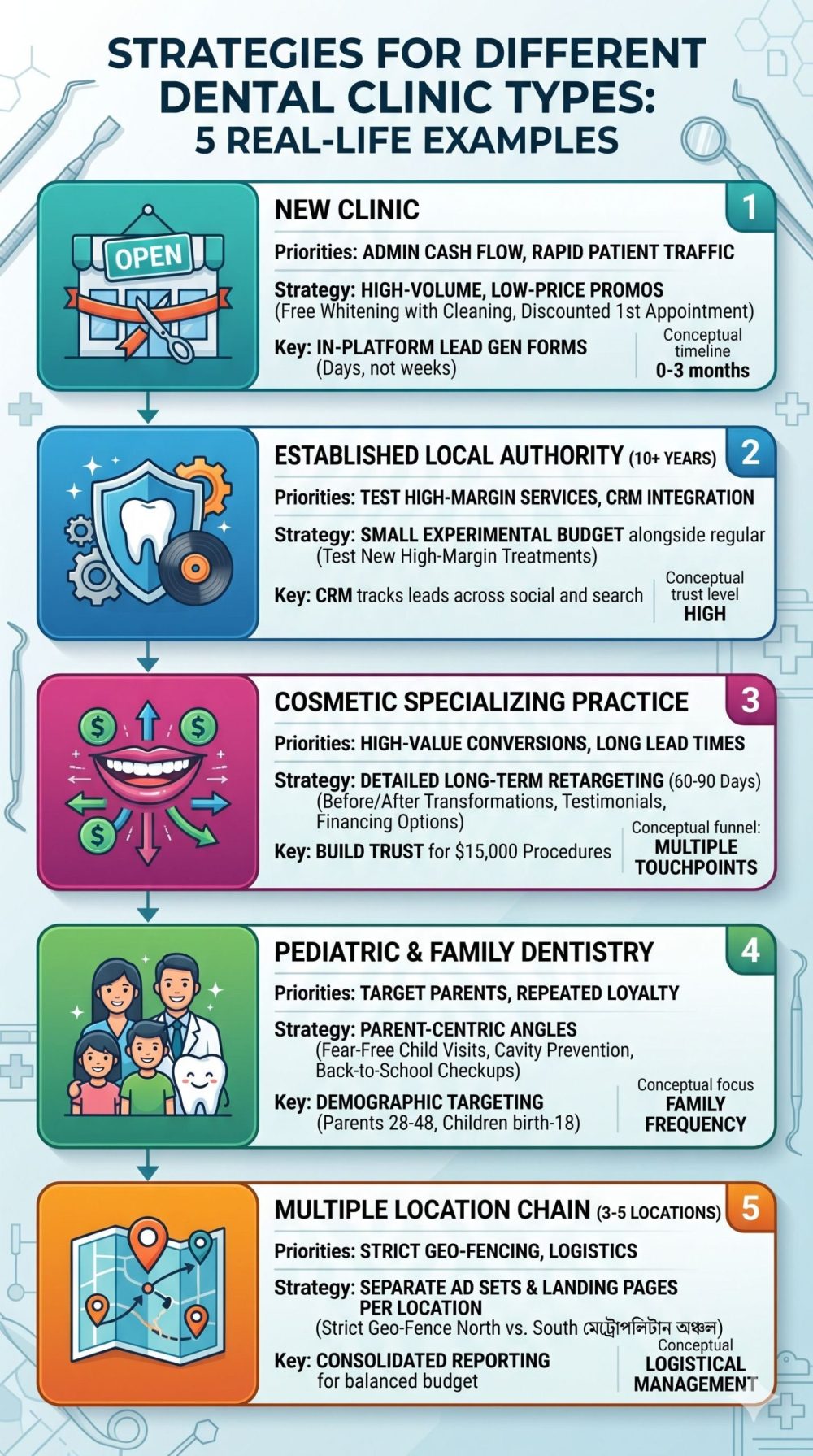
A strategy will not work for an established chain of clinics trying to consolidate their marketing efforts as it would for a brand new clinic opening its doors and needing patients now.
New clinic
This clinic has only $5000 to spend each month marketing and needs to start generating patient traffic right away.
Administrative cash flow is the most important factor.
As a result, the strategy for this clinic must be built around offering lower-priced and high-volume promotions. Examples of this type of promotion are discounted first appointments, free whitening at the same time as a cleaning, and family packages.
In terms of ad setup, direct response lead generation forms can be built directly into the advertising platform and do not require users to leave the ad to go to a landing page before submitting their information.
Therefore, the expected time frame from first bookable appointment to first booked appointment should be days, not weeks.
Established local authority clinic
This clinic has been operating for 10 years so its community has already built up some level of trust in the practice, and as a result, this clinic has established a strong foothold in local search.
Additionally, the local authority clinic enjoys a steady stream of referrals.
For these clinics, social ads act as an opportunity to test new high margin services. Therefore, the ad strategy for these clinics should include a smaller experimental budget in addition to the clinic's regular search campaigns.
Integration of this process is an important part of this strategy.
The community will want to ensure that the clinic's customer relationship management (CRM) software appropriately tracks, identifies, and credits leads who come from a video platform and those who come from a search engine.
Cosmetic specializing practice
This type of practice will generally have longer decision cycles.
The focus of the clinic's marketing efforts will typically be heavily weighted toward cosmetic type procedures such as veneers, implants, and orthodontics; therefore, the marketing strategy must account for a longer lead time and provide patients with plenty of reasons to return to the clinic between appointments.
A single 15-second video alone wouldn’t compel a patient to make an impulsive purchase of a $15,000 smile makeover.
A very detailed long-term retargeting strategy must be created for this scenario. The initial ads need to highlight extreme before-and-after transformations with the doctor’s credibility as the primary focus.
The layers of retargeting will then introduce the patient testimonials, available financing options and a detailed breakdown of the total procedure over a time frame of 60 to 90 days.
Pediatric and family dentistry
Family dentistry is a service with an emphasis on frequency and loyalty.
The decision-maker is typically the parent or caregiver, not the child.
Based on that, the creative approach to targeting must change. The horizontal is to target parent concerns; to alleviate a child’s fear of going to the dentist; to stop future cavities from forming; and to assist with scheduling back-to-school checkups.
The demographic targeting will need to ensure that budget is spent reaching children from birth to 18 years of age and parents between the ages of 28 and 48 who live within the targeted area.
Multiple location chain clinics
Chain clinics that have three to five locations within a metropolitan area face many logistical challenges.
To properly manage centralized marketing efforts, the clinic must geo-fence strictly for each individual location. For example, a person from the north end of the city should not receive an advertisement promoting the southern location.
This requires separate advertisement sets, landing pages for each location; and consolidated reporting dashboards to ensure that the budget is being spread out evenly among all the physical locations.
Separate treatment types
When planning campaigns for services at clinics, treat all dental services equally, and your marketing will end up wasting most of your budget.
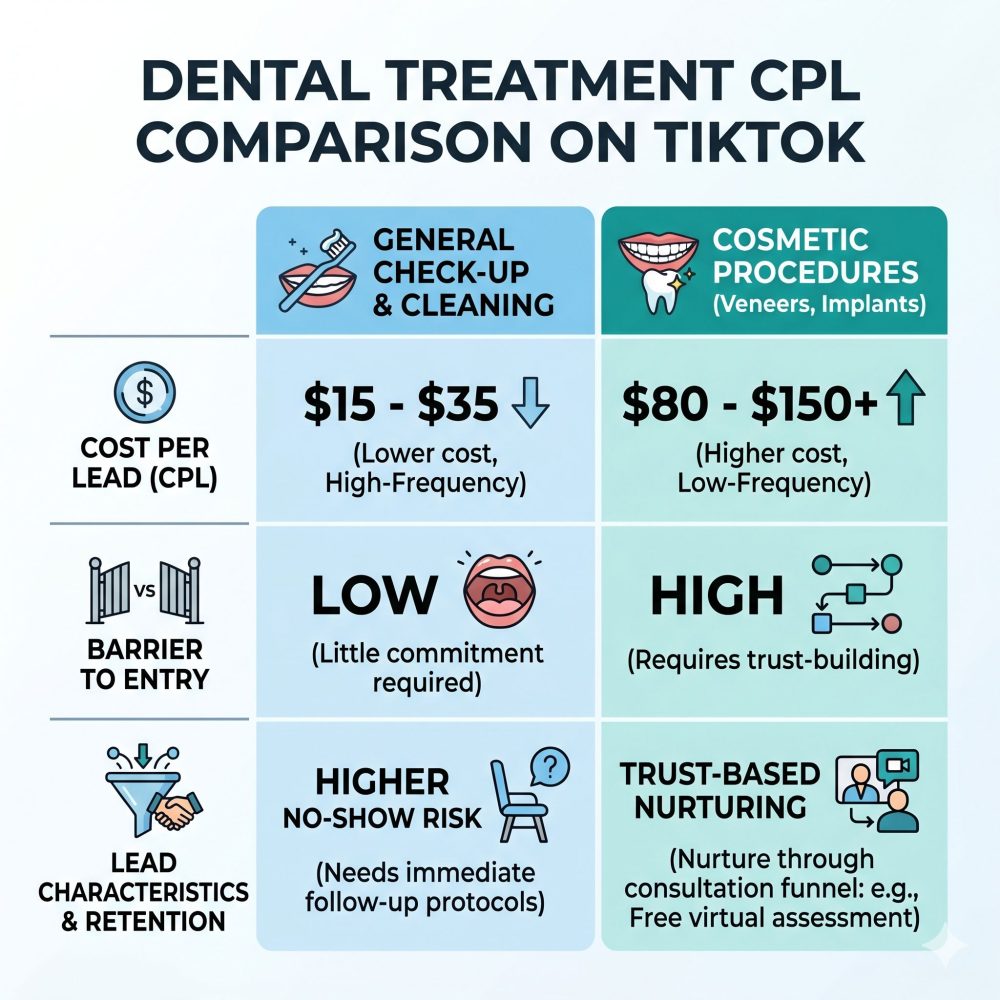
The cost per lead (CPL) and the cost per appointment (CPA) will vary greatly, depending on the specific treatment or service that is being promoted.
Emergency services
Social media is an inefficient platform for advertising emergency dental services.
This is a problem with interruption marketing.
The mathematical odds of reaching a person experiencing an acute episode of intense dental discomfort at the moment they are experiencing it is extremely unlikely; therefore, do not attempt emergency growth marketing effort through search intent networks.
General check-up and cleaning is essentially the foundational item of the lower cost, socially focused approach to market growth. The barrier to entry to use this strategy is fairly low.
For example, Local Dental Practices may find through targeting within a five-kilometer radius of their location, a CPL (Cost Per Lead) range of approximately $15 - $35 for their general check-up offer.
Because there is little commitment from the consumer, acquisition of these leads is comparatively easier; however, they tend to have a historically higher no-show rate.
Providers must implement immediate follow-up protocols to avoid losing the consumer.
Cosmetic dentistry procedures; however, provide a contrast to this story.
A CPL for cosmetic procedures usually ranges from $80 - $150 or more. While this is significantly higher than the general check-up CPL range, their return on investment in terms of increased revenue far outweighs the acquisition costs associated with these leads.
Still, the main friction point with acquiring leads for Cosmetic Dental Procedures is a lack of trust.
Therefore, leads generated for Cosmetic Dental Procedures should not be pushed to hard booking immediately. Instead, leads generated for Cosmetic Dental Procedures should be nurtured throughout the consultation funnel of care, beginning with a free informal virtual smile assessment or free introductory video call.
Navigating platform limitations and compliance
Healthcare Marketing is one of the most regulated industries in the world, which creates specific limitations for all digital media platforms.
In addition, many of these tools were not built to accommodate the regulatory requirements of the healthcare industry.
Often the friction points that Marketing Agencies typically overlook can quickly derail an active campaign.
Most Local Business Advice for Targeting Local Consumers would suggest the Hyper-Local (block) approach to Targeting Local Consumers. However, the reality is that all major video platforms have geographic targeting restrictions that do not allow for Hyper-Local Z+4 targeting.
In many parts of Canada, for example, advertisers can only Target Consumers with three-digit Forward Sortation Areas.
The algorithms that deliver ads in the United States are programmed to deliver ads to an audience. Therefore, if you target beyond a 5-mile radius from your clinic, it can restrict the algorithms from delivering any ads.
As a result, clinics must plan for geographic bleed and ask qualifying questions on lead forms to identify leads that may live outside the clinic's target area but may be able to commute there.
Compliance friction block
Dental clinics comply with strict regulations in each region, including HIPAA in the United States, GDC in the United Kingdom, and GDPR in Europe.
It is common for agencies to pitch their clients on "the raw, behind-the-scenes content". However, if the practitioner did not edit the unedited footage of a busy waiting area, this would violate patient privacy laws.
Commercially published before-and-after photos must have the explicit documented consent from patients.
It is also mandatory to get all necessary approvals from regulating bodies like the GDC.
A simple statement made by a practitioner regarding "pain-free dentistry" can warrant the suspension of an account and/or fine due to regulators.
Planning content for a clinic must include a three- to five-day lag time to accommodate for the internal review process.
Getting patient consent
Patient consent cannot be verbal.
Practices must create a standardized consent release that is included with the clinic's standard intake document.
This process must be implemented immediately: the receptionist must flag all patients who have signed the consent release form, and the clinical staff must only take video of those patients who have given consent.
Practices must consider the potential liability of relying solely on memory or verbal agreements from patients following appointments.
Mitigating "No-Shows"
Vanity metrics waste marketing dollars.
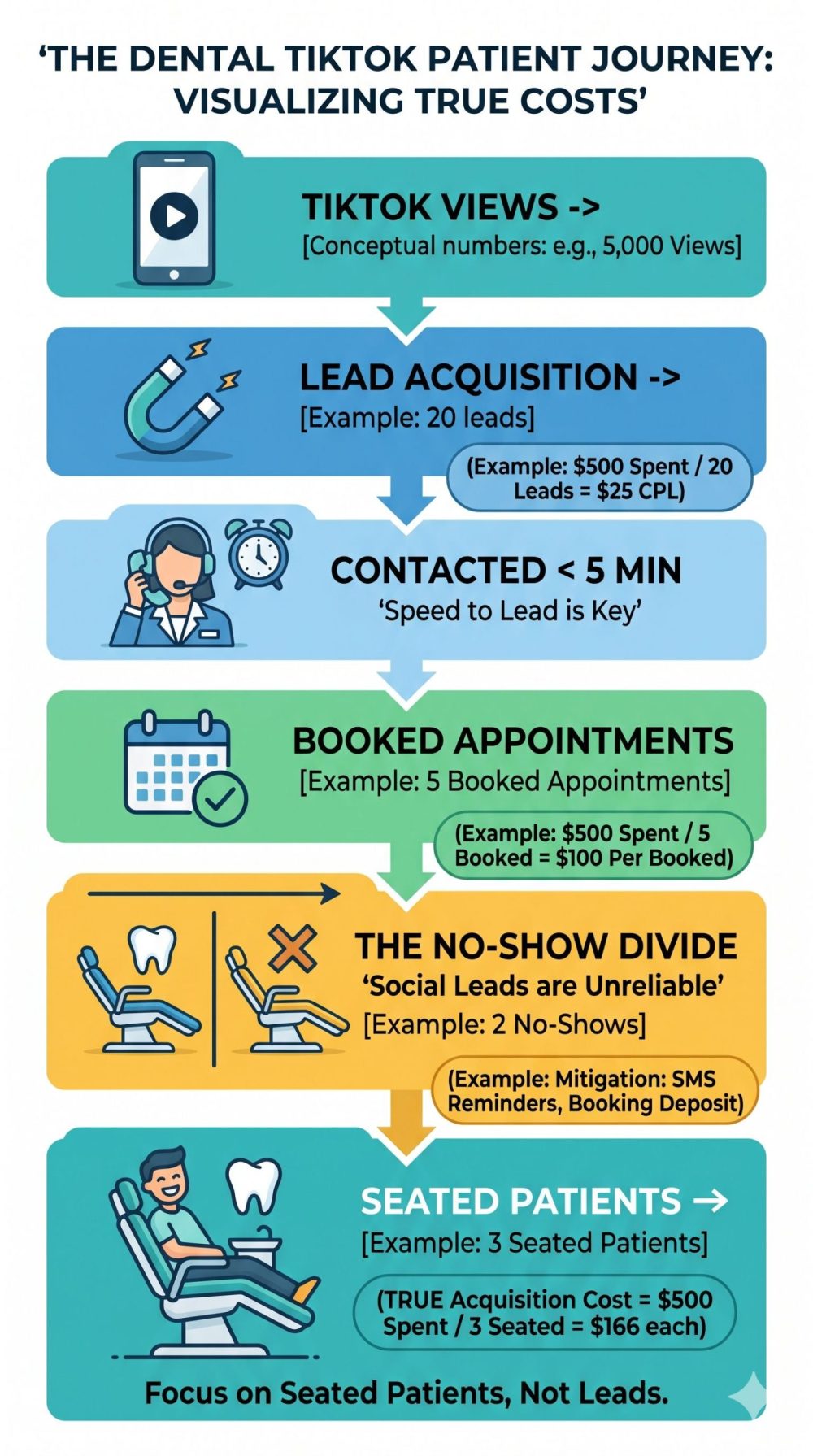
Metrics such as views, likes, and shares will not pay for the clinical overhead of clinics. The only metric a clinic should focus on is the "cost per booked appointment that showed up".
How much does it cost to fill a chair?
Having a solid understanding of the numbers behind the conversion funnel is key to knowing what can be realistically expected.
An example is as follows: A clinic spends $500 and generates 20 leads (at a cost of $25 each), and on the surface this would appear to be successful. However, industry statistics indicate that typical local leads convert to booked appointments at roughly a 20%-30% success rate.
Of those 20 leads, the clinic was able to secure five (5) booked appointments; thus the true cost to book was $100.
Stemming the tide at your front desk
Although the highest point of friction for dental marketers is the number of people who do not keep their scheduled appointments, social media leads tend to be more unreliable than referral leads.
If two (2) of the five (5) booked appointments do not show, then the true cost of acquiring a patient increases to $166.
Aggressive mitigation strategies should be implemented immediately.
Clinics should promptly send automated SMS reminders upon booking for each appointment and those that occur during peak demand periods should implement a nominal booking deposit (i.e., $50 toward treatment) to significantly decrease the number of no-shows.
In addition, all front desk staff should be trained to contact social media leads within five (5) minutes of their submission; nothing reduces the cost to acquire customers more than the speed at which you respond to leads.
Creating high-converting creative materials
The days of overly produced, polished corporate dental marketing commercials are gone.
Users see them as "ads" and quickly swipe over them.
Authentic imperfection is the way
The data has repeatedly shown that authenticity is more important than polish.
What does this mean?
It means that utilizing UGC-styled (User Generated Content) materials is the best way to obtain high conversion rates.
A provider's video should have the doctor speaking on camera using the same lighting found in a standard clinic, rather than in a studio environment with multiple cameras.
When the video has frame movement and has raw audio, it typically outperforms agency-created content.
The objective is to make the video appear like organic content that is found in the provider's target marketing platform.
Winning hook formulas
The first three seconds are of utmost importance when determining the cost of the click.
The most ineffective hooks include information such as "Welcome to Smith Family Dental." The most effective hooks are those which reveal something a person is curious to know, introduce contrast to their way of thinking, or provide some type of solution to a problem.
Functional angle examples include:
- "As a dentist, here are the three things I wouldn't do to my own teeth."
- "Find out how your coffee habit can damage your enamel, even if it only happens in the morning."
- "You may be surprised to find out that the reason your gums bleed is because you floss."
By using a functional angle, you are providing immediate educational insight, as well as establishing the practitioner as an outright authority in the area in question.
Landing page alignment
A great ad directing visitors to a poor-quality landing page = Failed campaign.
If the video advertisement discusses a specific discount for invisalign, the landing page must match the offer that was promoted in the ad.
Having users directed to your website's main page where they have to search for your offer is going to result in a high bounce rate.
The landing page wireframe must be extremely simple, including only a headline similar to your ad hook, a brief summarisation of what the offer is, the credentials of the doctor to establish credibility and an easily identifiable and above the fold booking form.
Staff management and execution timelines
Marketing is a man-hour driven activity.
Anything that claims to be "set and forget" is a marketing gimmick to produce software sales. The internal effort required to operate these campaigns must be calculated correctly by practitioners.
Friction in the setup phase
The first week is structurally oriented.
During this time, a business account must be created, compliance must be verified, tracking pixels must be placed on the clinic's website, and a connection to a CRM must be established.
This will require a dedicated administrative effort of five to ten hours in most cases.
This is frustrating, tedious, and entirely necessary.
The ongoing optimization phase
As soon as campaigns launch, the real work begins.
Employees need to spend time monitoring the inbox for patient inquiries. Comments made on ads should be monitored for spam and for valid patient inquiries.
Employees should call leads and work in a sustainable workflow that involves batch filmmaking.
A doctor can film eight short videos on a Friday afternoon for two hours and have them edited and scheduled for release throughout the following month.
This way, a doctor's daily work is not disrupted.
Preparing for 2026 Algorithm changes
The digital marketing landscape changes constantly.
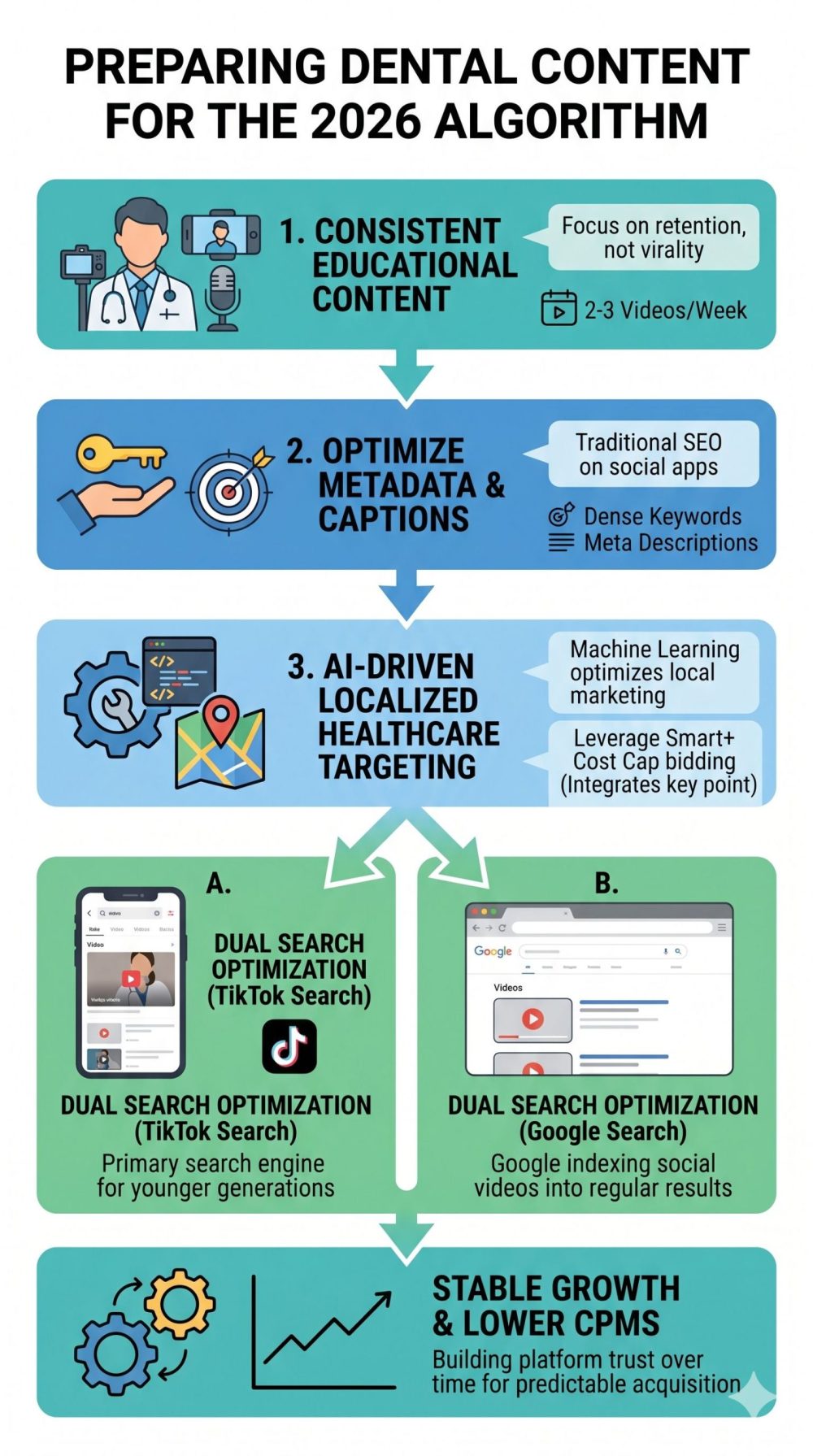
Strategies that were most effective in 2024 are being actively penalized in 2026.
No more chasing virality
The algorithm has improved significantly.
It now focuses on keeping users engaged and retaining them consistently rather than on wild, unpredictable viral spikes.
Clinics need to stop participating in unrelated dance fads with hopes of going viral. Instead, they need to produce a regular schedule of two to three high-quality educational videos every week.
By producing consistently, the platform builds trust over time, which will ultimately result in lower CPMs (cost per thousand) and more stable CPMs.
Smart+ cost cap maximization
Leveraging smart+ cost cap strategies to target localized healthcare marketing through the use of machine learning technology is being demonstrated in many recent case studies.
Clinics create a maximum price they will accept per lead using smart+ cost cap bidding strategies.
When the lead's total price exceeds this maximum, the system alerts the clinic and stops the lead from being delivered.
By using direct messaging type ad formats along with this specific configuration, clinics have reported reduced acquisition costs of up to 20% from their previous level.
Optimization of search across platforms
Social video platforms are quickly becoming primary search engines.
Younger generations are increasingly choosing to bypass Google and search directly in video apps for information such as "Best Dentist Near Me" or "Does Invisalign Hurt?" instead.
Also, Google is now indexing a large number of videos from social video platforms into its regular search results.
Therefore, optimizing video content for keywords is absolutely critical.
Captions should be optimized just as web pages are optimized for SEO with keywords being utilized in captions in a manner similar to that of traditional SEO meta descriptions.
Aligning on-screen text, spoken word, and hashtagging with regard to the proper keyword search terms will also help to increase dual platform visibility.
Takeaway
It is possible to develop a cost-effective TikTok advertising plan for a local dentist if the generic advice offered by large marketing agencies is eliminated.
A successful plan requires operational discipline, an in-depth knowledge of tracking metrics within the funnel, the ability to resolve issues presented by compliance, and effective communication from the office front desk staff in a rapid response manner.
When creating a budget for a dental clinic, it's important to customize the budget according to what the treatment actually costs to provide.
This is very different from cosmetic treatments and how the client relates to the provider.
This will allow the Clinic to turn an unsteady social media feed into a stable and measurable way to acquire patients.
Instead of chasing after vanity metrics, clinics should focus on "cost per seated patient," "cost cap bidding," and a rigorous process to optimize a patient's booking experience.
Frequently asked questions
When will local dental campaign's ROI be seen?
For a low-ticket, high-frequency campaign such as teeth whitening, the campaign should start generating leads in 48 to 72 hours after launch. In addition, the ROI is expected to be seen during the first 2-week period of the campaign. On the other hand, for a high-ticket, lower frequency cosmetic campaign such as dental implants, the ROI should be measured over a 60-90 day period due to the time needed for nurturing and the time required for consultation.
Are social video users too young to afford cosmetic dentistry?
This has been proven false through math.
While the platform started out targeting a younger audience (people in their teens and twenties), today the audience is mostly people in their thirties and forties, many of whom can afford to purchase this type of service. Social Media Advertising targeting methods can easily provide access to these audiences.
What is a realistic cost per lead for dental implants on the local level?
The reality of the local advertising agency's market makes it difficult to determine a firm number.
However, through campaign analysis from multiple local agencies for this type of offer across multiple markets, it would be anticipated that the cost (CPL) for a dental implant for a local clinic within a 5 km-10 km radius would fall between $80-$150 based on how much the clinic nurtures their leads after the lead has come from the campaign.
