
Customer acquisition vs customer retention - which one is better and more profitable for your business?
While many brands find themselves in this dilemma, the fact is that both of them are crucial to steering your business towards sustainable growth.
Still, it seems like constantly adding new customers is more important than consistently serving the ones that have already made a purchase.
This is precisely why brands and businesses focus aggressively on customer acquisition (44%) while customer retention trickles down the priority ladder (18%), even when offers more value.
A Bain&Company report showed that a mere 5% increase in customer retention can boost your profits by 25%.
Further, when it comes to selling, existing customers are 60 to 70% more likely to buy as compared to new customers (5 to 20%).
How to balance customer acquisition and customer retention? How to find out your customer retention rate and customer acquisition rate?
Here, we explore the answers to these and many other questions.
What is customer acquisition?
Customer acquisition means identifying and developing sales opportunities in all the sales channels and expecting them to close the sales.
During customer acquisition, the brands and businesses engage with prospects and align their sales efforts throughout the prospects' purchase journey.
In simpler terms, customer acquisition means identifying, targeting, engaging, and converting new leads or prospects.
Take a look at the following image to understand the customer acquisition meaning and the entire process in a better manner:
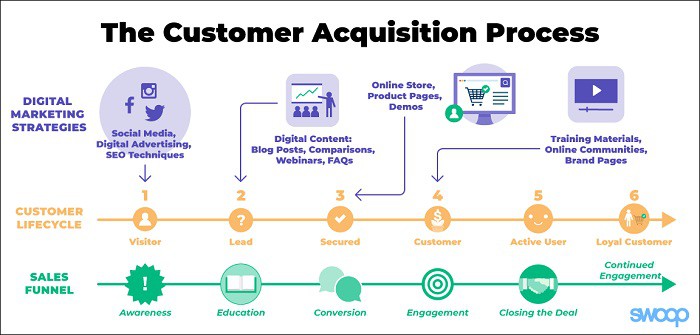
As shown in the image, getting new customers for your business is a resource-intensive process. You have to target your customers on various platforms, via personalized content and deliver exceptional experiences throughout their journeys.
The digital customer journey encapsulates the online path a consumer takes from initial awareness to the final purchase or interaction with a product or service. It begins with digital touchpoints like social media, websites, or search engines, where customers discover and explore offerings. The journey culminates in the transaction or engagement phase, where seamless user experience and personalized interactions play a pivotal role.
Knowing the difference between customer acquisition and retention is essential, but so is setting up your company correctly – that's where one of the best llc services can help you navigate the legal landscape with ease.
Next, we discuss how to calculate the costs of new customer acquisition.
How to measure customer acquisition cost?
Customer acquisition cost or CAC comprises the amount of money you spend on getting a new customer. By measuring the CAC, you can determine the ROI of your customer acquisition efforts.
You can calculate the CAC by adding all the costs of converting prospects into customers divided by the number of customers acquired.
The costs of acquiring new customers can be of different types such as:

Let us try to understand this with the help of an example.
Suppose Molly sells handmade furniture items and uses sustainable resources to create custom pieces.
She is actively working on getting new customers and has taken the following steps:
After 6 months, she wishes to track the financials to figure out how much does it cost her to acquire new customers.
Then, her financial expenses on getting new customers would be:
Marketing Tool | Cost per unit | Quantity | Expenses |
Sales and Marketing Team | $50,000 | 2 | $100,000 |
Social Media Campaigning | $1,000 | 10 | $10,000 |
Pay-per-click advertising | $0.50 | 20,000 | $10,000 |
Magazine Ads | $500 | 12 | $6000 |
Total Marketing Expenses: | $126,000 | ||
New Customers Acquired: | 2,000 | ||
CAC: | $63 |
Hence, Molly’s CAC for the past 6 months is $63 per customer.
However, this is just the beginning of calculating CAC thoroughly. For the best calculations, you also have to consider the amount each customer spends that is calculated using customer lifetime value or CLV.
CLV and CAC are not mathematically disparate and if they are inversely proportional, then your business is profiting. So, your goal must be to have a higher CLV and lower CAC.
This happens when you streamline your customer acquisition strategies and work on the three major boosters of CLV - customer retention, cross-selling and upselling.
Next, we discuss some of the best ways to acquire new customers.
What are the most effective customer acquisition strategies?
Effective customer acquisition strategies focus on the entire customer journey instead of standalone touchpoints. Hence, you are able to work on retention alongside customer acquisition.
We share some of the best acquisition engagement retention strategies that will help you grab more customers and guide them to become loyal brand advocates gradually.
Identify the target audience
Even before you start looking for the best ways to gain customers, you need to identify "who" are your customers. Identifying and targeting the right potential audiences for your business is critical to the success of your acquisition efforts.
It is highly likely for your brand offerings to be relevant to only a specific customer demographic.
Hence, it is important to discover those relevant audiences first, and then focus on the best ways to target, engage and convert them.
In-depth market research is one of the most reliable ways to do so as you can get data visualizations that can steer your core business decisions throughout the customer journey.
For example, Starbucks relies on complete and thorough market research, and one commendable example is when the brand spelled all the customers' names wrong on their coffee cups to boost its social media following.
Opt for the right customer acquisition channel
Not all customers shop via Facebook ads, and not all customers prefer exclusive brand websites for online shopping.
Some of them might be more comfortable shopping via Whatsapp groups where a lot of other people are also there and everyone is able to connect with you 24X7.
So, knowing the right channel for customer acquisition is as important as identifying the right audiences.
While you can always opt for the most popular channels, such as social media or eCommerce websites, the best way to choose the right channel involves experimenting with all the best options.
Start with setting clear goals for your brand offerings, customers, and campaigns.
Having a structure of how the entire process will go about will also help you understand whether your customer acquisitions tactics are going to produce positive results or not.
Segment, target, and position (STP) your efforts
STP is a famous marketing technique that allows you to target and engage your customers in a better manner and direct them towards conversion in a more confident way.
However, it can prove to be extremely handy in customer acquisition as well.
Take a look at the following image to understand how STP works:
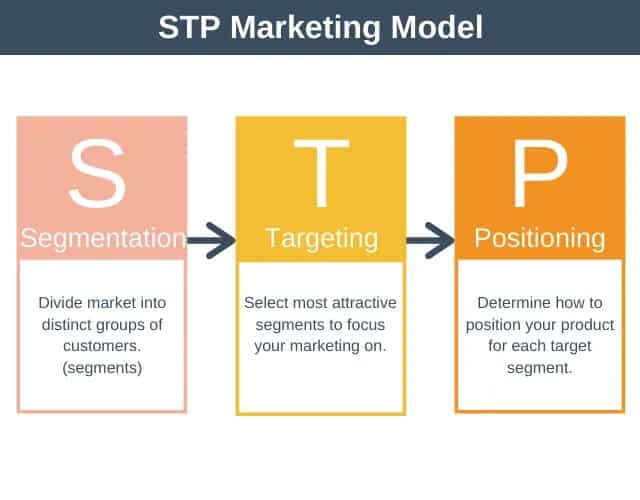
STP becomes easier when your market research is complete because you have the entire market and customer data. You can create different customer segments based on specific criteria, such as - location, age, gender, purchase power, etc.
Once the customer segments are created, you can target each one of them with personalized and highly curated content offerings, such as ads, campaigns, etc.
Finally, you can position your brand offerings in the most relevant ways to each customer segment, such as:
This way, you can target your customers in a more confident manner.
Giveaways
If you are going to enter a highly competitive market, you might need to offer more than just words or promises to attract, engage and convert your audiences.
If the customer pool you are targeting is already using a quality brand, the common influencer or word-of-mouth marketing might also not be enough to make them switch.
In these situations, you can opt for giveaways that allow you to grow your network in a rapid manner and also helps you generate leads across multiple platforms.
You can save money by steering clear of expensive paid promotions or influencer marketing and also, amplify your product exposure.
Keep the content quality high
Content marketing is one of the best ways to help your prospects understand your products better. Blogs, videos, social media posts, and emails - all of them have immense potential when it comes to acquisition retention engagement.
However, it is important to ensure that your content is highly relevant and targeted to your customers. Its quality is going to generate the desired emotions of purchase, browsing, and investing in your brand offerings.
A poor commercial with improper analysis can lead to fiascos such as the infamous Kendall Jenner Pepsi commercial. It continues to draw flak even after years, so much so, that Coke had to release a statement specifically to deny advertising with her later.
Next, we discuss customer retention to help you have a better and more in-depth understanding of customer acquisition vs retention.
What is customer retention?
All the activities and efforts you make to keep your existing customers and engage them consistently with your brand offerings come under customer retention.
High customer retention means that a very few of your customers are leaving or stopping doing business with you.
This is also called customer churn, or customer attrition, and is a popular metric to measure the profitability of your business.
If you have a higher customer churn rate, then it directly points out that your customers are leaving you and there is something wrong with your brand offerings or services.
Customer retention focuses on keeping the existing customers happy and engaged. So, it allows you to build upon their first impressions and guide them towards brand loyalty with personalized and more streamlined efforts.
Take a look at the following image to understand the process of customer retention:
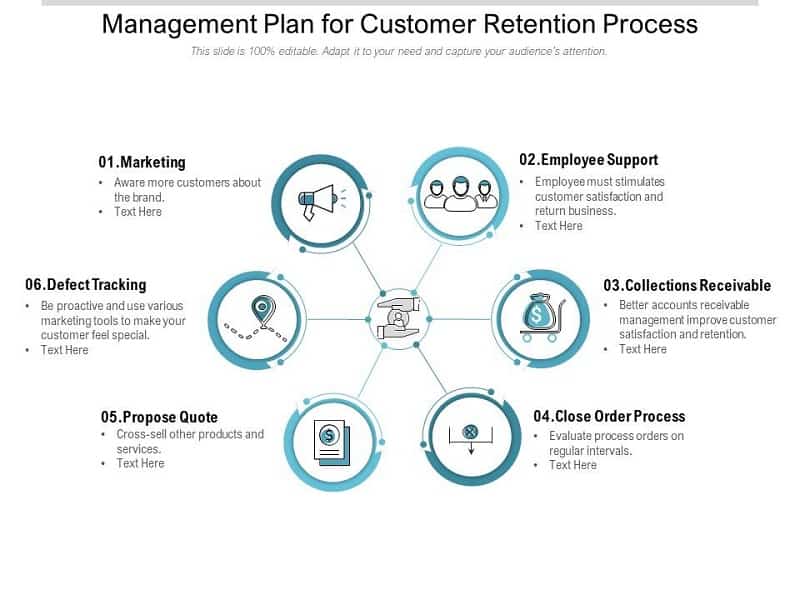
The rate of your customer retention is called customer retention rate, which is also an important metric for measuring CLV and business profitability.
How to measure customer retention rate?
Customer retention rate or CRR is the number of customers you retain over a specific period of time, and is calculated via the following formula:
[(E-N)/S] x 100 = CRR
Here:
For example, suppose you wish to measure your CRR for 6 months, say January to June and your customer numbers are as follows:
Then, by using this formula, your CRR = [(4000-200)/4400] x 100, i.e. 86%.
Now, your retention rate is the inverse of your customer churn rate. So, in this case, the customer churn rate is 14%.
These two metrics are of extreme importance as they are direct indicators of the direction your business is headed. If your customer churn rate is high, then the CRR goes down and you are in dire need of keeping your customers.
But then again, how to do that?
What are the most effective customer retention strategies today?
How do you ensure that your customers don't leave your brand or stop doing business with you after one sale?
Below, we share some of the best strategies to increase your customer retention.
Focus on long-term relationships
Long-term relationships have their foundation in trust. Fostering trust involves focusing on every aspect of the customer experience. To build long-term relationships you have to deliver relevance and value throughout the customer journey.
Some of the key considerations for developing long-term relationships include:
Make the most of your customer data
When it comes to data in customer acquisition vs retention, existing customers offer a consistently available data stream. Further, you can review or survey these customers to figure out their preferences and purchase motivations.
You can process this customer data with advanced analytics to find out any hidden trends and patterns in it, such as:
Apart from sales stats, you can figure out the major pain points of your customers and deliver improved experiences.
Marketing automation for re-engagement
Using marketing automation allows you to automate your marketing processes for customer re-engagement. You can create automated workflows for keeping the customers engaged and active at all times.
Smart marketing automation also allows you to keep a track of important metrics, such as the number of customers that have lapsed, their response to your recent re-engagement efforts, etc.
Build upon previous customer loyalty experiences
If you wish to keep your loyal customers loyal always, then you need to consistently send the message that you value them and care about giving something back to them.
Offering a robust and personalized loyalty program is one way to do so. Apart from allowing you to expand your retention efforts, the loyalty programs also help you connect with your customers at a deeper level.
Some pointers that you can keep in mind for creating highly effective loyalty programs are:
Personalized communications
Personalization is one of the best customer acquisition and retention strategies that can leave a positive impression on your customers’ minds.
Personalization comes in various forms, such as:
Personalization allows your brand offerings to be always relevant and well-aligned with your customers’ expectations and preferences.
Should you be focusing more on customer acquisition or retention?
To get the answer to this question, have a look at the following image that shows customer retention vs acquisition stats:
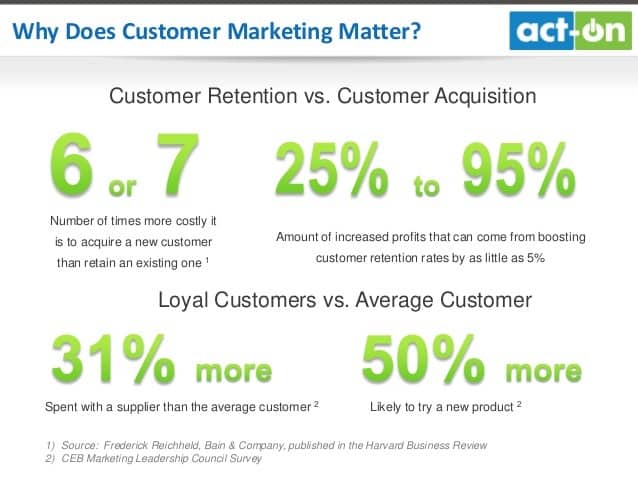
Apart from the sales and conversions benefits that focus on customer retention offers, there are some other challenges that make retention more favorable than acquisition.
Some of these challenges are mentioned below:
Hence, customer retention is more important than customer acquisition. However, this doesn't mean that you must not increase your customer base. It is important to get new customers for your business as well.
So, the key is to balance your marketing and targeting efforts such that both customer acquisition and customer retention can be worked upon.
Getting started: how, where, and when?
Be it retention or acquisition, one thing is clear - customer data is of immense importance. Having reliable customer data management and analytics platforms, such as a helpdesk software can help you do the job.
Also, there is no end to learning, experimenting, and refining your customer service and marketing strategies; especially if you wish to stay market-relevant.
Finally, it is important to not make the entire ordeal a strict customer acquisition vs retention process. You just have to balance your focus and make the most of both, acquisition and retention.
