
Your customers keep asking for features. Support tickets pile up. A big client threatens to leave unless you ship "just one more integration." So you build it.
Then another request arrives. And another. Six months later the product is fuller, the team is tired, and retention has barely moved.
Listening to customers mattered. Treating every request as a roadmap item did not.
Listening matters. Copying their solution usually doesn't.
Customers are often excellent at describing problems, frustrations, and goals. They are not necessarily the best people to design the fix.
When someone asks for Feature X, they are usually pointing at a pain. The feature itself is only their first guess at relief.
That distinction sounds small. It isn't. Teams that treat feedback as a to-do list ship more and learn less.
Teams that treat feedback as evidence about problems ship less, but what they ship tends to stick.
This distinction between listening to customers and letting customers dictate your roadmap is a core part of customer-centric product development: understand the problem deeply, then use your own judgment to choose the solution.
If you run an online business or a small SaaS without a dedicated product team, you do not need a full product-management operating system to apply this.
You need a clearer way to read the signals you already get.
Pull feedback from more than one place
A roadmap built only from the loudest inbox is a roadmap built on sampling bias.
One angry email can drown out ten quiet customers who churned without complaining.
One enthusiastic power user can sound like "the market" when they are mostly describing their own workflow.
Collect the same themes from several channels before you treat a request as urgent:
- Customer conversations and onboarding calls
- Support tickets and live chat transcripts
- Reviews and social mentions
- Sales calls and lost-deal notes
- Product analytics (where people stall, drop off, or never return)
- Cancellation reasons and exit surveys
You are looking for overlap.
When the same friction shows up in support, in churn notes, and in how people actually use the product, you have a stronger signal than when it appears in only one place.
A single channel can still teach you something. It should not decide the quarter on its own.
Look for the job behind the feature request
When a customer asks for Feature X, do not start by estimating how hard Feature X is to build. Start by asking what they are trying to accomplish.
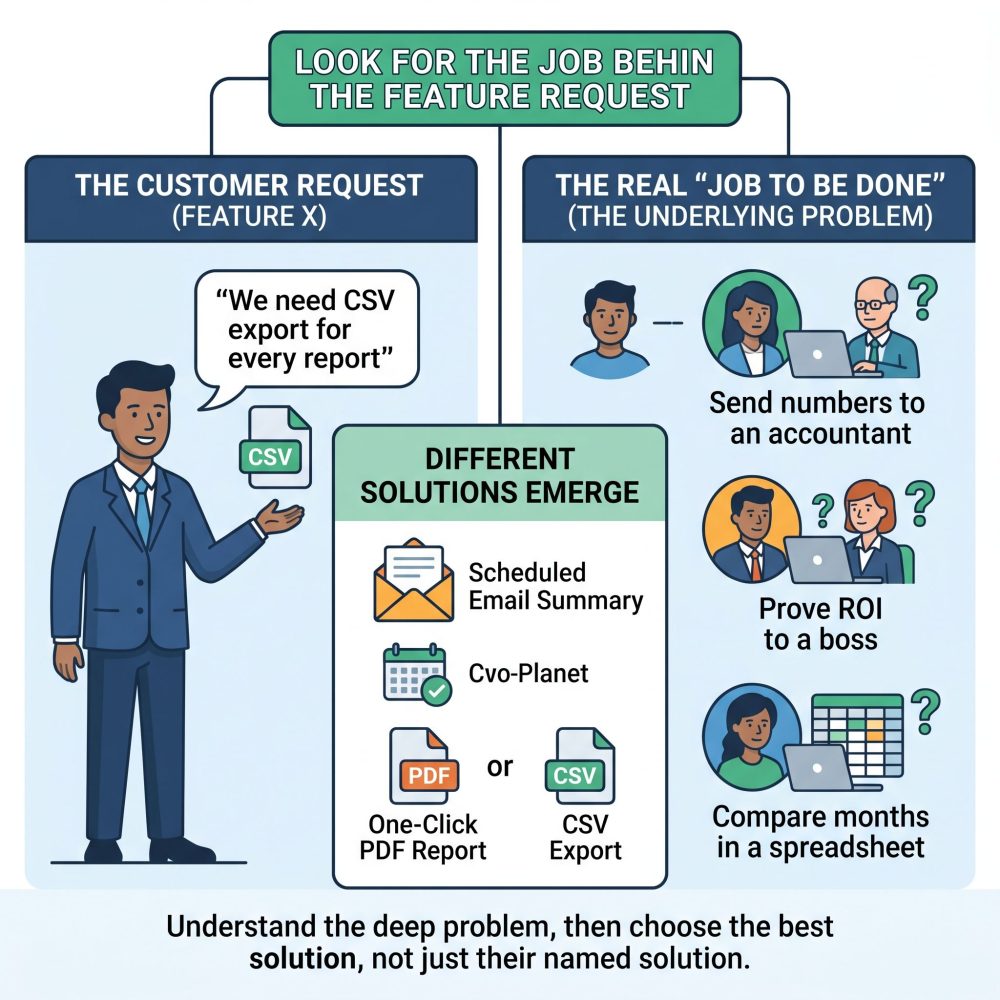
Imagine an ecommerce SaaS customer saying, "We need CSV export for every report." The request is clear.
The underlying job might be something else entirely: sending numbers to an accountant, comparing months in a spreadsheet, or proving ROI to a boss who does not log into your product.
Those jobs can lead to very different solutions. Sometimes a scheduled email summary beats a raw export.
Sometimes a one-click PDF is enough. Sometimes export really is the right answer. You only know after you understand the job.
The same pattern shows up with "we need more dashboards," "we need Slack alerts," or "we need a mobile app." Each one might be a real need.
Each one might also be a shortcut phrase for "I cannot get the right information to the right person at the right time."
If you build the phrase instead of the job, you can ship something that looks responsive and still leaves the customer stuck.
A useful follow-up sounds ordinary: "Walk me through the last time you needed that. What did you do instead?"
Past behavior beats future fantasy. People are polite about ideas. They are much more honest about what already cost them time, money, or credibility last Tuesday.
What "good evidence" sounds like
Strong signals usually include specifics: a date, a workaround, a failed attempt, a dollar or hour cost.
Weak signals sound like compliments, hypotheticals, or vague enthusiasm ("I'd definitely use that"). Both can appear in the same conversation. Your job is to weight them differently.
If a customer cannot point to a real instance of the problem, park the request. It may still matter later. It is not yet strong enough to consume a development sprint.
Patterns beat loud voices
One passionate customer can feel impossible to ignore, especially when they pay a large invoice. Still, one voice is one voice.
Before a request becomes a roadmap item, ask how many customers in your target segment hit the same problem, how often it shows up, and how painful it is when it does.
Frequency without pain is noise. Pain without frequency can still deserve a workaround or a concierge fix, not a permanent product investment.
Pain that is frequent among the customers you actually want to keep is where roadmap time belongs.
A practical habit: keep a simple theme list instead of a raw feature backlog.
When "export," "notifications," and "mobile" keep reappearing, group them under the underlying jobs you hear (prove results to a boss, catch issues earlier, work away from a desk).
Themes make patterns visible. A raw list of feature names hides them. This is also where "customer-led" quietly goes wrong.
Building every request from your biggest account can grow revenue in the short term and warp the product for everyone else.
The account feels heard. The broader market gets a tool shaped around one workflow. That trade-off is sometimes worth it. Make it consciously, not by accident.
Prioritize problems before you prioritize solutions
Once you have a pile of feedback, resist the urge to rank features. Rank problems first.
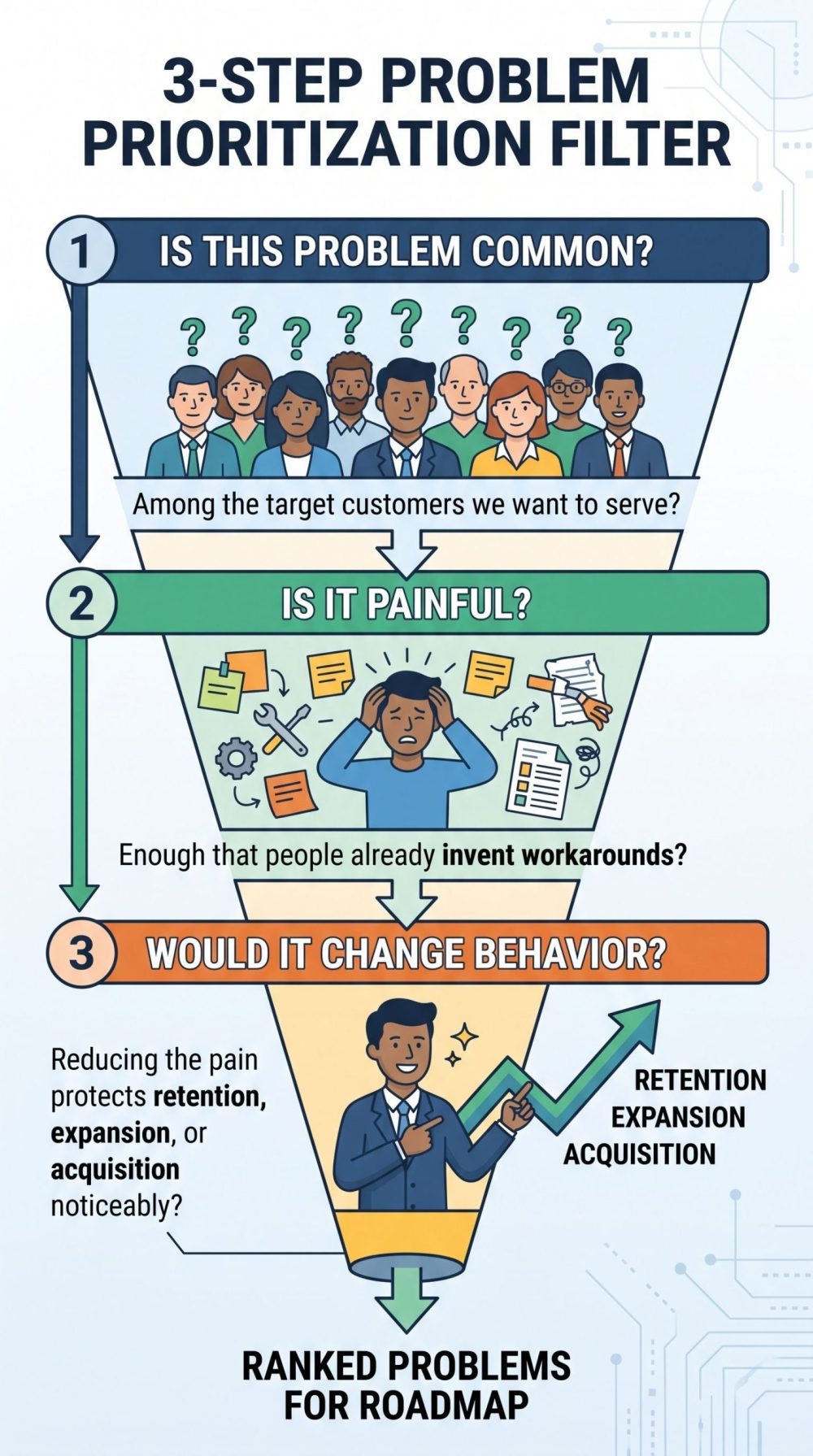
A simple filter works for most small teams:
- Is this problem common among the customers we want to serve?
- Is it painful enough that people already invent workarounds?
- If we reduced that pain, would it protect retention, expansion, or acquisition in a way we can notice?
Only after a problem clears that bar should you explore solutions. Several solutions may fit the same problem.
The first one a customer named is rarely the only option, and it is not automatically the cheapest or the best.
If two problems both look real, prefer the one that shows up across channels and sits closer to your core value.
A niche request from a segment you are not trying to win can wait, even when the requester is persuasive.
Test cheap before you commit expensive build time
Shipping a full feature is an expensive way to learn whether you understood the problem.
Before you commit significant development time, look for a smaller test that would change your mind.
That test can be a clickable prototype, a landing page that describes the outcome and measures interest, a manual workflow you run for five customers, or a limited beta behind a feature flag.
The format matters less than the question: do people use this in a way that suggests the problem was real and the direction is right?
A manual workaround is especially underrated.
If you can solve the job for a few customers by hand for two weeks, you learn the edge cases before you encode them in software.
You also learn whether customers even show up for the "solution" once it exists. Many requests die quietly at this stage.
That is a successful test, not a failed feature. Be honest about what would falsify the idea.
If nobody clicks, nobody books the concierge offer, or nobody changes their workaround after seeing the prototype, do not "just build a smaller version anyway."
Treat the miss as information and return to the problem.
After you ship, measure what changed for the customer
"We shipped it" is not a result. The useful question is what changed for the customer. Did the task take less time?
Did support tickets on that topic drop? Did more people complete the workflow successfully? Did retention or expansion move for the segment you targeted?
Pick one or two customer outcomes before you build, then check them after release.
If nothing moved, you learned something important: the request may have been a proxy for a different problem, or the solution may have missed the job. Either way, you now have better evidence than another opinion in the backlog.
And if your product is already overloaded with unused features because years of "customer-driven" shipping left you with complexity and little lift, pause the request treadmill.
Cleaning up delivery, technical debt, and a swollen roadmap is sometimes the highest-leverage move.
That is where software project support can help you stabilize what you have before you add more.
Conclusion
Customer feedback is fuel. It is not a steering wheel by itself.
Collect it from several places, dig for the problem behind the request, trust patterns over loud voices, ask about real past behavior, prioritize painful problems for the customers you want, test before you fully build, and measure whether the customer's life actually improved.
Do that consistently and you will still disappoint some requesters. You will also stop burning months on features that sounded urgent and changed nothing.
Want a more systematic way to turn customer evidence into product decisions? Read the complete customer-centric product development framework.
