
Most business owners budget for legal fees, for software subscriptions, for the accountant who catches the mistake before it costs you. Almost nobody budgets properly for legal document translation, until the invoice for a single vendor contract comes back higher than the deal it was supposed to protect.
If your business signs agreements, terms, or disclosures across borders, translation isn't a one-time cost. It's a recurring expense that scales with every new market, every new hire, and every new deal you close outside your home language. And in 2026, most businesses are still pricing it the old way: by the word, by the page, and by the rush fee.
What Legal Translation Actually Costs
Legal translation runs higher than everyday business translation because the margin for error is so much smaller. According to Tomedes, translation prices vary in 2026, with specialized content like legal and medical translation typically running $0.15 to $0.30 per word depending on language pair, document type, and urgency.
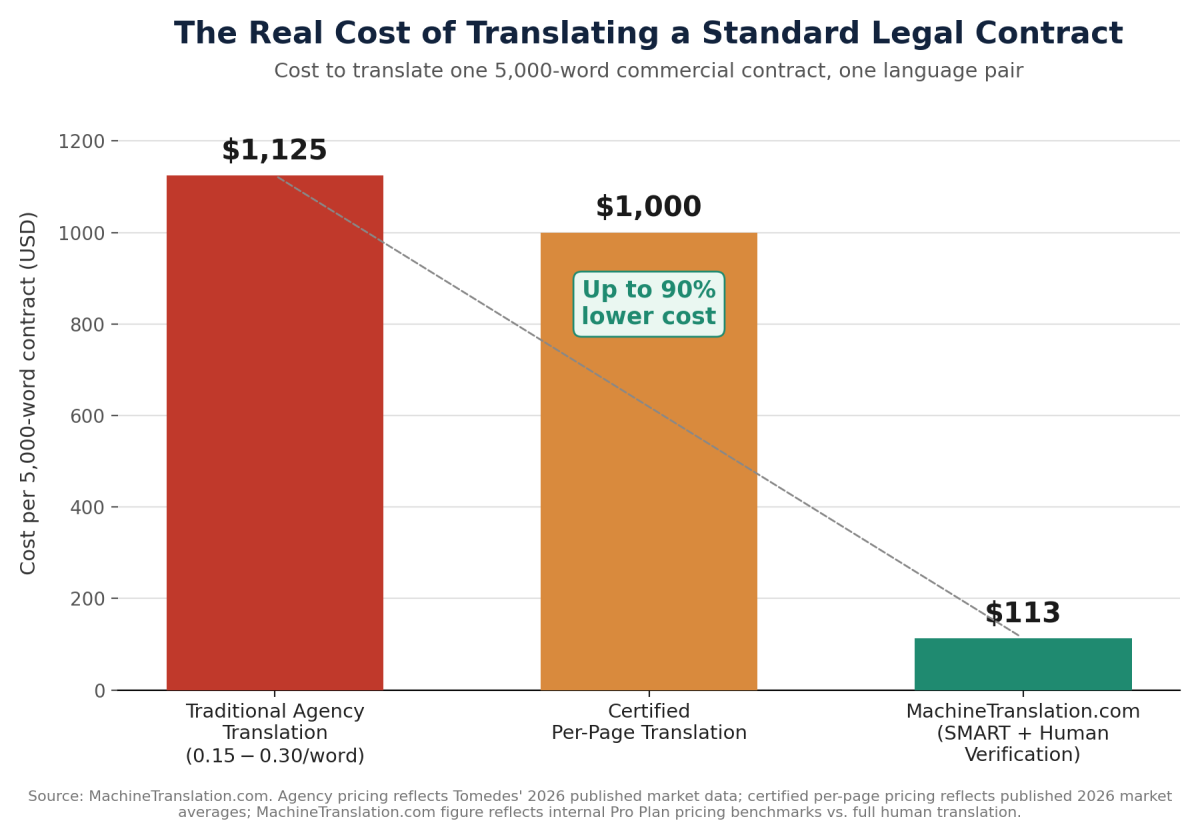
Run the math on a standard 5,000-word commercial contract. At the midpoint of that range, that's roughly $1,125 for one language, one direction. Negotiating with vendors in three markets in three languages easily turns a single agreement into a $3,300-plus translation bill before anyone on your team has even read a clause.
That's before certification fees, notarization, or a second review pass, all of which are pretty standard for anything with legal weight behind it. If your business signs a handful of contracts a quarter, translation quietly becomes one of the least visible, least forecasted line items on the books.
The Real Risk Isn't the Invoice, It's the Clause
Cost is the problem you can see. The bigger one is what happens when a translation is wrong.
Legal language doesn't tolerate approximation. A phrase like "without prejudice" or "null and void" carries specific legal weight in English that doesn't automatically transfer to the closest equivalent in another language. The same goes for a binding arbitration clause translated from English to Japanese, where the difference between a dispute resolution mechanism that holds up and one that gets challenged in court often comes down to a handful of words.
This is exactly where relying on a single AI model turns from a shortcut into a genuine liability. Industry data synthesized from Intento and the WMT24 benchmark, detailed in the State of Translation Automation 2025 report, shows individual large language models fabricating or mis-rendering content in translation tasks at rates between 10% and 18%. In a marketing email, that's an awkward sentence. In a contract, that's a clause somebody can argue about in front of a judge.
It's the same logic behind what to know before signing a non-compete agreement: the wording is the whole ballgame. A non-compete that's slightly mistranslated can become unenforceable, or worse, enforceable in ways nobody intended. If you wouldn't sign a contract you hadn't read carefully in your own language, you shouldn't sign one you can't be sure was translated carefully into someone else's.
Why 22 Models Beat One
The businesses getting this right in 2026 have stopped asking "which AI translator is most accurate" and started asking "how do I stop trusting any single answer at all."
That shift in thinking is the entire premise behind MachineTranslation.com, an AI translation platform built around a mechanism called SMART. Instead of running your contract through one model and hoping it got the terminology right, SMART runs the same text through 22 leading AI models simultaneously, evaluates the source context, and returns only the translation the majority of those models agree on. Individual models disagree with each other constantly, and that disagreement compounds the longer and more technical the document gets. Consensus is what tells you which output to actually trust.

The result, by MachineTranslation.com's own benchmarking, is a 90% reduction in translation error risk compared to relying on a single model, with hallucination rates falling under 2% for consensus output versus the 10% to 18% range typical of standalone systems. For legal content specifically, the platform layers a Human Verification step on top of the consensus output, escalating the translation to a professional reviewer within the same platform for a 100% accuracy guarantee, without a separate agency engagement or a new vendor contract to sign.
Running the Actual Numbers
Here's where the cost conversation and the accuracy conversation meet.
A business running its cross-border contracts through a traditional agency at $0.15 to $0.30 per word is paying for a single translator's read of the document, plus overhead, plus turnaround time measured in days. A business running the same document through MachineTranslation.com's consensus workflow, with Human Verification applied only where it's actually needed for legal weight, saves at least 90% of the cost of full human translation, according to internal MachineTranslation.com pricing data.
For a business signing a handful of international contracts a year, that difference is a few thousand dollars. For one negotiating vendor terms across a dozen markets, it's the difference between treating translation as a real line item in the budget and treating it as an afterthought that quietly eats into deal margin every single time, the same way unmanaged trade finance documentation can eat into margin on the payments side of a cross-border deal if nobody's watching it closely.
A Cross-Border Contract Checklist for 2026
Before your next agreement crosses a language line, run through this:
1. Price it before you need it. Get a real per-word or per-page estimate for your most common language pairs so a surprise invoice never derails a deal timeline.
2. Flag anything with dispute-resolution language for extra review. Arbitration clauses, indemnification terms, and liability caps are where a single wrong word does the most damage.
3. Separate "good enough" from "must be certain." An internal memo and a signed contract don't carry the same translation risk, and they shouldn't go through the same process.
4. Ask how the accuracy claim was reached. "Powered by AI" tells you nothing about whether the output was checked against anything. Consensus across multiple models, backed by a human verification option, tells you a lot more.
5. Build it into the deal timeline, not around it. If you're already budgeting time for legal review on a cross-border contract, translation belongs in that same planning window, not bolted on at the end.
Legal document translation isn't going away as a cost of doing business across borders. But in 2026, the businesses still treating it as a fixed, unavoidable expense are leaving money on the table and taking on avoidable risk while they do it. The ones running the numbers, and running the translation through more than one model before trusting the result, are the ones who can actually put a figure on what they saved.
