
The decision to build crypto trading infrastructure is usually made in a boardroom by people who aren't engineers.
They see competitors launching exchanges, they see trading volume as an opportunity, and they ask: "Who do we hire to build this?"
The answer matters more than most people realize.
A bad choice can cost 18 months of engineering time and millions of dollars with nothing to show for it. A good choice gets you to market in 3 months.
How do you choose?
The vendor categories: Build, buy, or hybrid
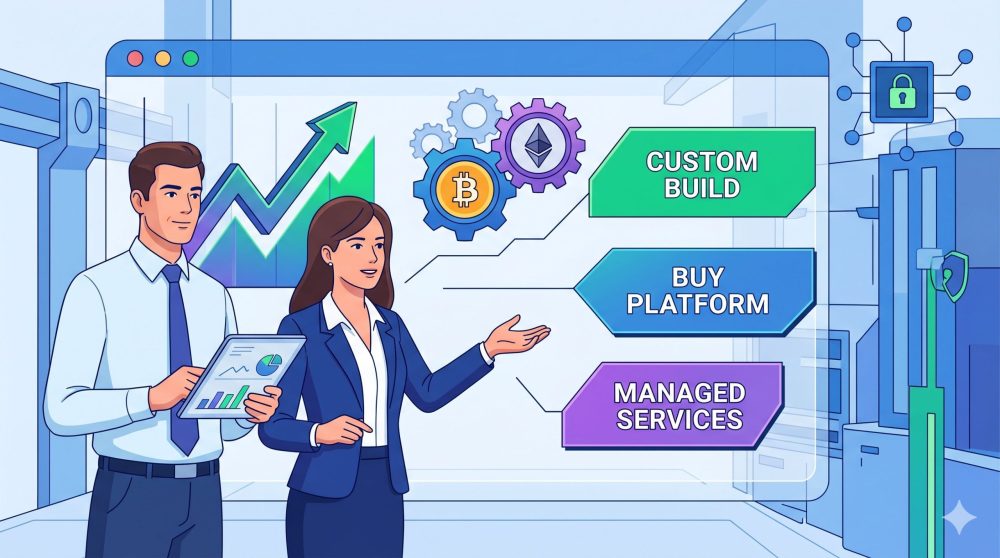
There are three categories of companies that help you get exchange infrastructure:
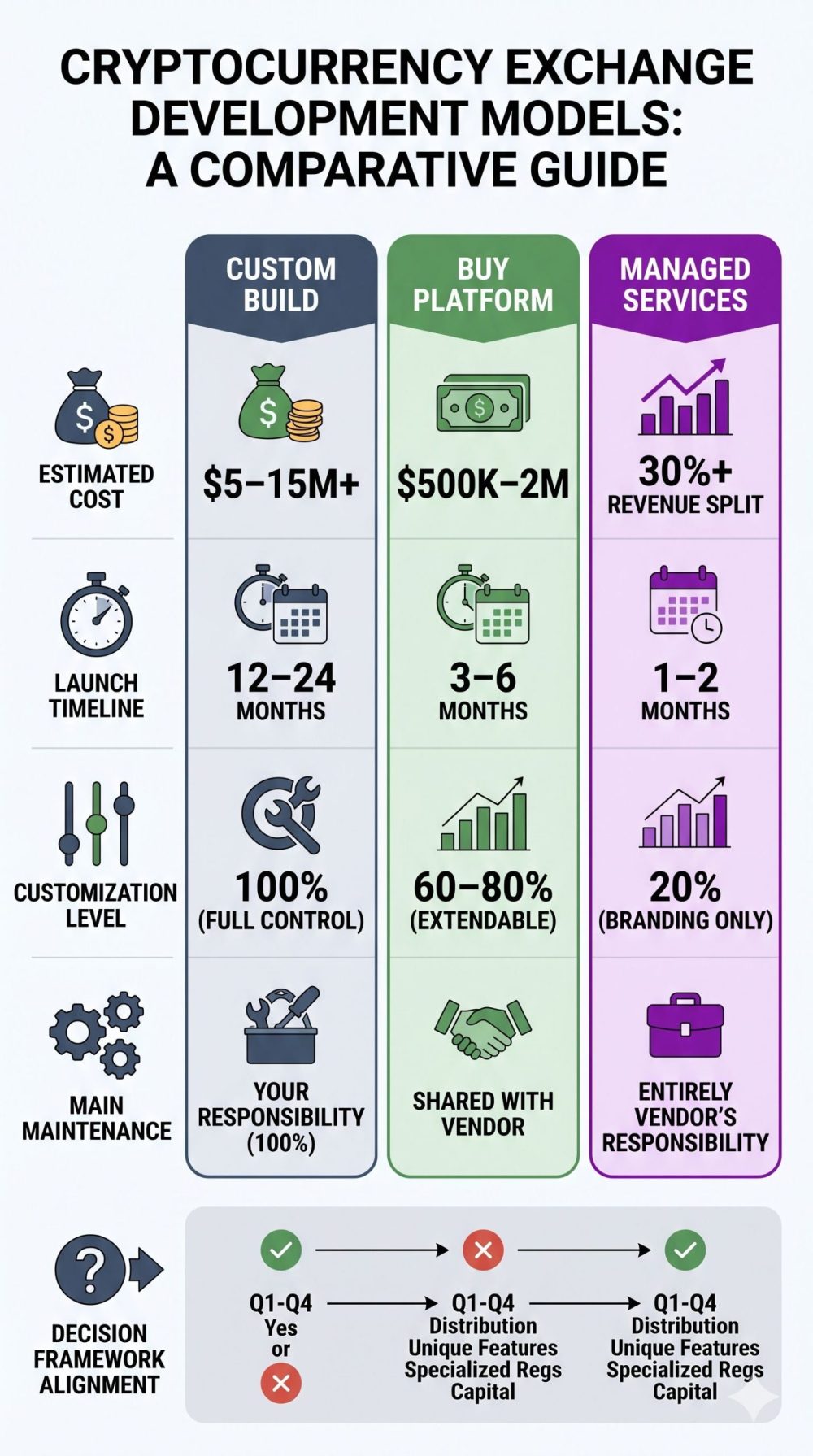
Custom builders: Engineering firms that build exchange software from scratch. Cost: $5–15M. Timeline: 12–24 months. Customization: 100%. Ongoing maintenance: your responsibility.
Platform providers: Companies that offer exchange software as a service. You deploy their platform, customize it, integrate it. Cost: $500K–2M. Timeline: 3–6 months. Customization: 60–80%. Ongoing maintenance: shared with the vendor.
Managed services: Companies that run the entire exchange for you. You're a reseller or partner. Cost: 30% of revenue or higher. Timeline: 1–2 months. Customization: 20%. Ongoing maintenance: entirely the vendor's responsibility.
Each model is right in different scenarios. The error most companies make is choosing the wrong model for their situation.
The decision framework: Build, buy, or outsource
Ask yourself four questions:
Question 1: Do you have existing customers or distribution?
If yes: Buy a platform. You don't need 100% customization. You need fast time-to-market. You have users ready to adopt, so the platform features are enough.
If no: Consider outsourcing or partnering. Don't build. A custom exchange requires organic marketing and you don't have distribution.
Question 2: Do you need features that off-the-shelf platforms don't offer?
If yes: Build custom or find a platform vendor that can extend their product for you. Customization has a cost, but some features genuinely require it.
If no: Buy. Use the platform as-is. Customization is expensive; avoid it if you can.
Question 3: Do you have a specialized regulatory requirement?
If yes: Find a vendor with experience in your jurisdiction. This is more important than customization. A vendor who's already navigated compliance in your region saves months of legal work.
If no: Platform vendors all handle standard KYC/AML. You're fine with any established player.
Question 4: How much capital do you have to burn?
If $5M+: You can afford custom builds. You get full control at the cost of time and money.
If $1–5M: Buy a platform. Customize where needed. You get reasonable features in reasonable time.
If <$1M: Partner with a managed services provider. You don't have enough capital to build or deploy a full platform yourself.
Your answers to these four questions determine your path.
Evaluating platform vendors: The technical checklist
If you're buying a platform, evaluate vendors on:
Multi-chain support. Does the vendor support the blockchains you care about (Bitcoin, Ethereum, Solana, etc.)? Do they add new chains regularly?
Custody options. Does the vendor integrate with custody providers you trust? Can you self-custody if you need to?
Scalability. Can the platform handle your projected volume? Have they tested this? What's their architecture?
Compliance framework. What jurisdictions do they support? Do they have AML/KYC integrations? Can they file suspicious activity reports?
APIs and integrations. Do they expose REST/WebSocket APIs for traders? Can they integrate with your backend systems?
Security. Have they been audited? Do they publish security reports? What's their key management strategy?
Support and SLA. What support tiers do they offer? What's their uptime guarantee? What's the response time for critical issues?
Ask each vendor these questions. Their answers separate serious vendors from amateurs.
Evaluating custom builders: The business checklist
If you're building custom, evaluate builders on:
Track record. Have they built exchanges before? How many? How many are still operating? Ask for references.
Team. Do they have blockchain engineers, security specialists, and compliance expertise? Or are they general software shops?
Timeline estimate. How long do they estimate your project? (Multiply by 1.5 for reality.) Have their past projects come in on time?
Price fixed or variable. Do they quote a fixed price or hourly? (Fixed price is better but rarer.) What's included in the quote?
Ongoing support. After launch, who maintains the code? Who does security updates? What happens when Bitcoin forks?
References. Talk to 3 companies that used them. Ask specifically about timeline overruns and surprise costs.
The red flags
Red flag: "This will be the most customized exchange ever." Customization is expensive. If a builder is promising features that no one else offers, either they're underestimating complexity or they're going to overcharge you later.
Red flag: "We'll build it faster than anyone else." Exchanges are complex. Any builder promising 6 months when others say 12 months is lying or underestimating. Be suspicious.
Red flag: "Our platform does everything." No platform does everything. A vendor claiming 100% feature coverage hasn't been honest about trade-offs. They're either leaving something out or lying.
Red flag: "You can launch with minimal compliance." Regulatory compliance isn't optional. If a vendor is suggesting you skip it or minimize it, they're giving you bad advice.
Red flag: "We don't need a dedicated security audit." Every exchange needs security audits. If a vendor doesn't plan for this, they're not serious.
The real cost of choosing wrong
Choosing the wrong vendor can cost years and millions of dollars. A custom builder that overruns timelines by 12 months costs an extra $3M+ in engineering alone.
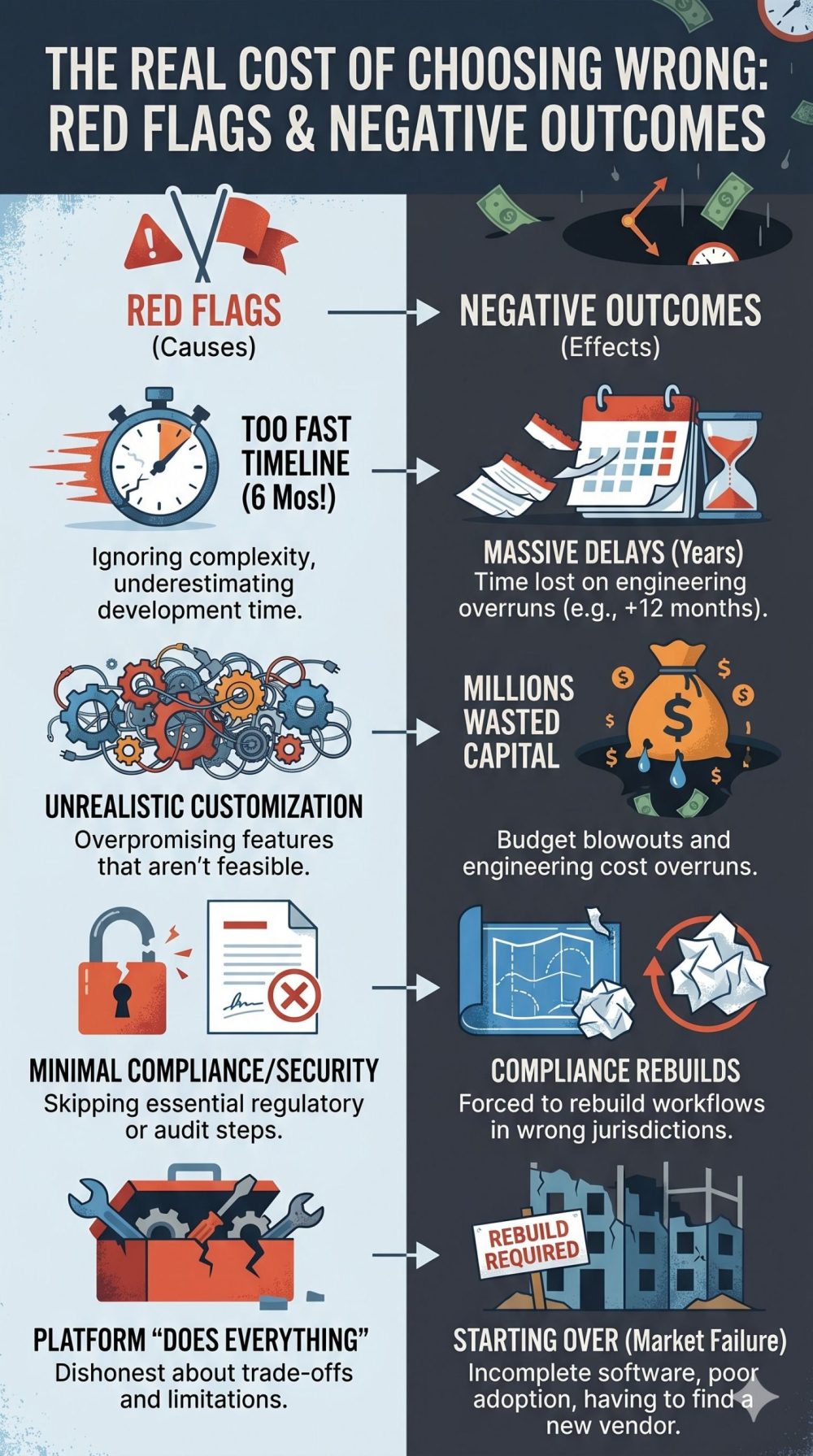
A platform that doesn't support your key jurisdiction forces you to rebuild compliance workflows.
Before you sign a contract, get multiple quotes. Talk to references. Get everything in writing.
The right choice usually feels obvious
The right vendor usually stands out when you do diligence.
They have relevant experience, they answer your questions directly, they're realistic about timelines, and their past customers speak positively about them.
The wrong vendors try to oversell. They promise everything. They're vague about timelines. They deflect when you ask hard questions.
When selecting a cryptocurrency exchange platform development company, trust your instinct. The process of evaluating vendors is itself the most important part.
