
The first mistake that companies make when creating a compensation plan for the first marketing hire is assuming the role of marketing will be treated the same way as sales.
Many organizations simply take their commission structure from sales, attach it to a revenue target, and expect to see the marketing engine start to explode.
However, this approach leads to the same, predictable results: marketers manipulating easily-countable but relatively meaningless (or low-intent) metrics; sales and marketing misalignment; and paying bonuses on leads that never convert.
Unlike a sales executive with a quota that is clearly defined by what is referred to as 'closed-won' signatures, your first marketing hires will work in an environment that is complex and filled with uncertainty.
Attribution will typically be imprecise. Sales cycles can take several quarters to close.
Hence, the marketer's actions today could take anywhere from one month to nine months to have a tangible impact on your bottom line.
While human resources and other generic incentive guides will advise creating measurable Key Performance Indicators (KPIs), such advice will not work for all companies in their early-development phases.
In order to establish a framework that actually places the proper balance on the three competing realities of what the marketer can truly control, what attribution can be trusted, and whether or not cash flow exists to support payouts, companies must be more creative in their thinking.
Core principles for marketing incentives
- Ensure the right balance between quality and quantity. A good way to keep sales people honest is to provide bonuses based on the number of leads generated, and yet protect against "bad leads" by using other metrics such as Sales Qualified Leads (SQLs) or Contribution Margin.
- Create a minimum threshold and maximum cap for bonuses. For any type of bonus, the company must reach a minimum level of survival before any bonuses are triggered. To help early-stage companies protect their cash flow, all bonuses should be capped.
- Use blended scorecards to compensate both individual contributor metrics and the overall business. Establishing blended scorecards ensures that all sales and marketing teams work together toward achieving the same goals.
- Run simulations of proposed bonus formulas before finalizing. Before implementing any new bonus structure, you should always run it against data from the previous quarter. If the formula does not produce logical results, it is likely broken.
Why generic bonus plans fail in early-stage marketing
A lot of the information available for determining a company's compensation structure is based on large companies that have substantial historical data, seasonality, and a dedicated revenue operations team.
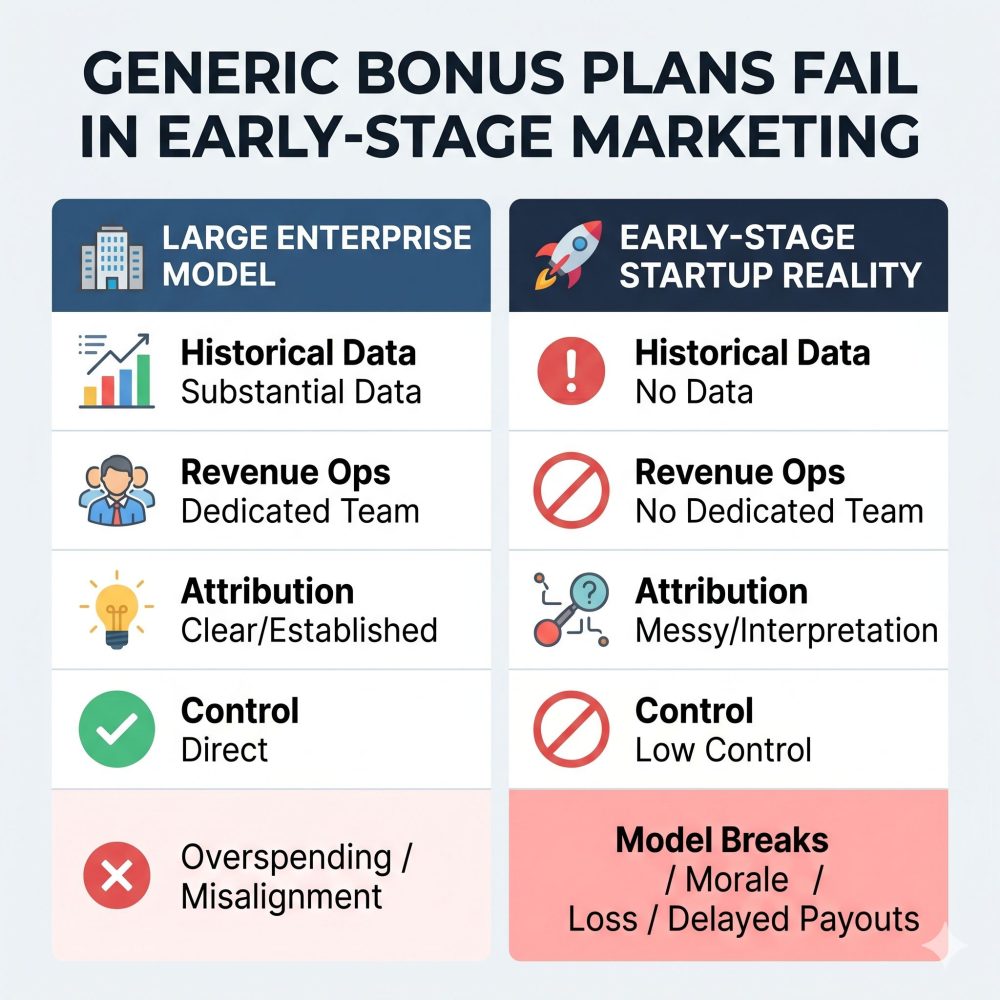
For a startup, none of those factors exists.
When you attempt to enforce the enterprise model onto an early-stage marketing team, you are going to break the model at three distinct failure points.
Attribution is messy in early-stage businesses
As a result of being a small company, attribution can be very subject to interpretation.
For example, a prospect may see a post on LinkedIn by the company founder, read an article written by a content marketer, and ultimately make a purchase after receiving an email from a "cold-caller" (sales development rep).
Who receives a commission on the sale?
If your marketing bonus is based on the last click attribution methodology, the marketing person will ignore building their brand and go after bidding on "high-intent" search terms, starving their top-of-the-funnel.
The concept of direct control
The concept of direct control often leads to ideas about how to establish metrics to drive employee behavior.
However, bonuses attached to unreasonably high levels of responsibility for metrics that an individual could not realistically influence create a moral hazard.
For example, if a demand generation marketer is compensated solely on the basis that a majority of the revenue generated after closing deals goes to a sales team, then the marketer's ability to earn additional bonus payments will depend entirely on the performance of the sales team and whether or not the sales team successfully closes deals.
If the sales team fails to follow through on sales opportunities, then the marketer may have produced a high-quality pipeline, but he or she may not receive an incentive based on the outstanding performance of his or her hard work.
The result is a significant loss of morale.
Cash-constrained realities
In addition to implementing a compensation plan that permits bonus payments to continue to build upon themselves, as is traditional practice within HR, in a cash-constrained startup environment it is possible for a significant portion of bonus payouts due to a result of an unprecedented frenzy resulting from the viral nature of a marketing campaign to be delayed as a result of extreme cash constraints caused by a sudden increase in cash flow.
Thus, while cash flow, like other parts of a cash-restricted environment, can limit a company's ability to pay out bonuses based on performance, cash flow restrictions may also delay the paying out of bonuses.
The decisions core matrix
The Decisions Core Matrix for defining performance-based bonus plans must include three dimensions: controllability, attribution, and cash flow.
Prior to listing any performance metrics in an offer letter that detail what type of performance will earn a bonus payment, leadership must run the proposed bonus program through an extremely detailed and thorough operational review.
While effective compensation plans for early-stage marketing departments should not necessarily rely on one universal indicator to reflect an employee's performance, early-stage compensation plans generally utilize one of three factors as a foundation to build upon.
1. Controllable metrics
Has the employee made a realistic effort over time to change the number represented in the metric?
2. Attribution
How well is the performance metric aligned with other factors that influence the marketing department's overall revenue generation?
How many dollars are received from each of the department's sales and marketing activities?
3. Cash
How quickly do the revenues generated by the marketing department show up in the company's cash flow?
Even with a significant amount of revenue generated through marketing campaign activity, it is possible that it will take many months for those dollars to be deposited into the company's cash management account.
Because the revenues generated by the marketing organization may take many months to get deposited into the company's cash account, early-stage marketers should focus on recording performance metrics based on leading indicators (revenue-generating pipeline leads, cost of customer acquisition, etc.) and limiting the use of trailing indicators (for example, corporate valuation, generic monthly recurring revenue) to a limited number of employees who work within the marketing organization.
The reliability of lead attribution
Is it possible for a company to track this metric without manual intervention or dispute?
If it takes a team four hours of debate at each quarter about which department "owns" a lead in order to calculate a bonus, then there are serious issues with the system. (As we pointed out earlier, early CRMs are typically a complete mess).
If you cannot automate lead attribution or reach agreement on lead attribution via simple and straightforward CRM reports, then you should never base employee pay on lead attribution.
When lead attribution is weak, switch to either blended metrics or team-based scorecards.
The safety and timing of cash payouts
Can the company afford the payout when it's due?
In the early days, companies must protect their runway. Therefore, bonus plans should include affordability gates.
If the company does not meet its primary revenue target, individual marketing bonuses should either be scaled back or stopped depending on the number of leads generated.
The timing of the cash payouts should also correlate with the company's cash conversion cycle.
A role-based marketing incentive framework
Different roles within the marketing function require different types of incentive structures.
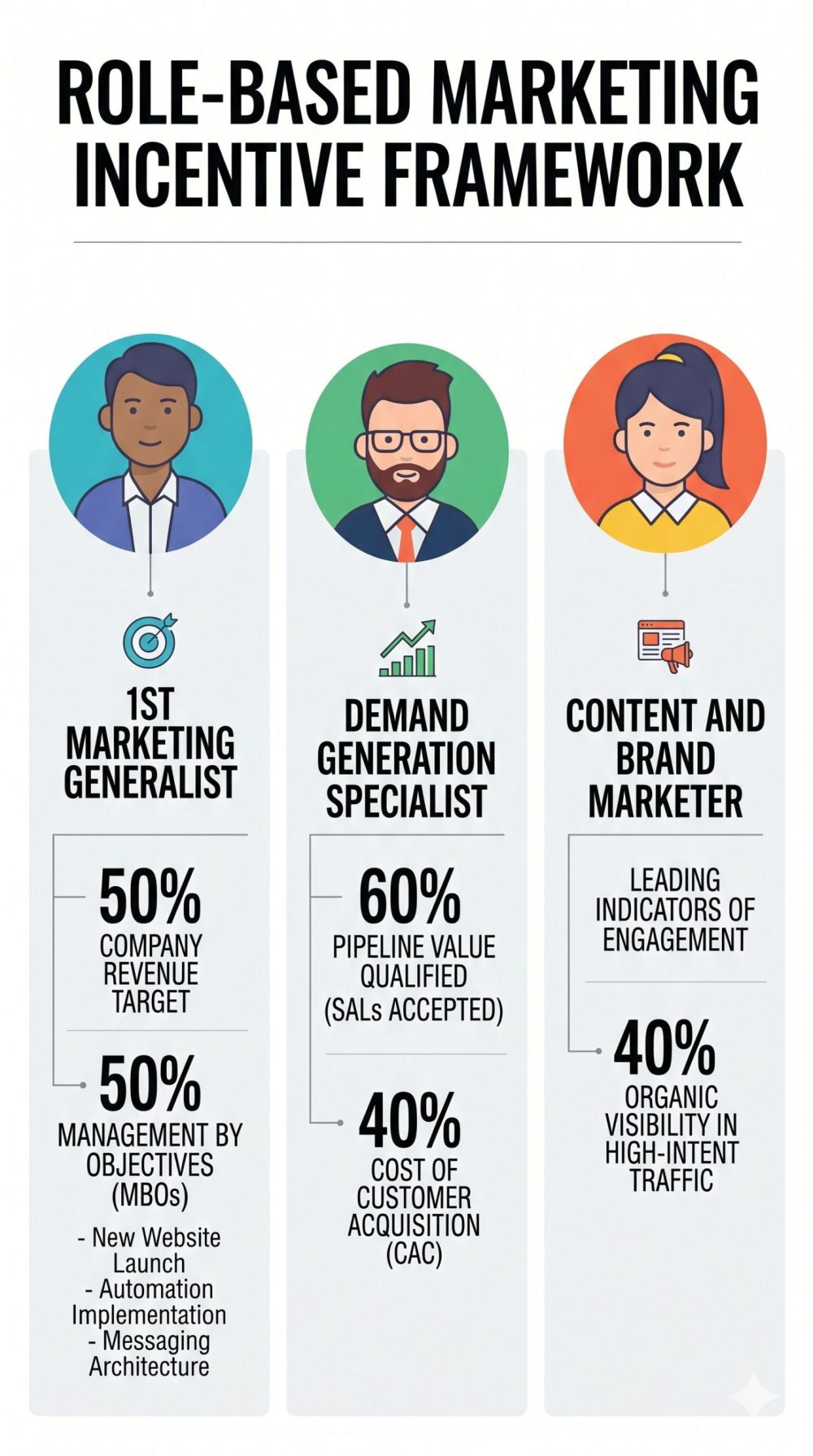
Treating the technical growth marketer as the same as the brand storyteller will lead to misaligned behaviors.
This is how to create a plan for each of your marketers reflecting the unique operational realities of their roles.
The first marketing generalist
The first marketing hire is often going to be a generalist that builds the foundation for your marketing department.
Their responsibilities span tactical execution, strategic positioning, and vendor management.
Due to the variability of their outputs and the fact that most early CRMs track leads poorly, it is very risky to tie bonuses to one particular metric.
Corporate Structure Suggestions: 1:1 Mixed Method, Company Team Scorecard
- 50% Company Revenue Target. Keeps everyone focused on the end goal while aligning the Company Team with the Founder's vision.
- 50% Management by Objectives Method (MBO). The MBOs that serve as a foundation for determining how much a team will be compensated. Example of MBO's include the successful launch of a New Website, the successful implementation of a new Marketing Automation Platform and the establishment of the Initial Core Messaging Architecture (ICMA).
Demand generation specialists
The Demand Generation Specialists represent the most quantifiable Marketing function within a marketing organisation.
Demand Generation Specialists (DGSs) are hired to build sales pipeline and increase operational efficiencies, however care must be taken not to fall into the trap of rewarding DGSs based solely on the volume of Marketing Qualified Leads (MQLs) that they generate.
If DGSs are compensated on the number of MQLs they generate, they will send an overwhelming number of worthless leads (e.g. ebook downloads) to the Sales Team.
Pipeline Quality and Efficiency
- 60% of Pipeline Value Qualified. Determine bonus amount based on the dollar amount associated with the Opportunities that the Sales Team accepts. This creates a reason for the DGS to care about Lead Quality and Intent.
- 40% (CAC). Create incentives to produce opportunities for the Sales Team while ensuring the Startup does not spend unnecessary cash.
Content and brand marketers
In Content Marketing, the focus has to be on producing compelling, quality content that resonates with and engages customers.
The goal of a content marketer is to build a quality content library over time, and to establish a loyal audience around quality content produced over time.
In order to receive performance bonuses for any short-term revenue from content, performance bonuses must reflect that there is a gap between the date a content marketer produces the content and the time a content marketer receives a bonus for revenue from the content.
Leading Indicators of Engagement
- 40% Organic Visibility Increase in High-Intent Traffic for Commercial Search Terms. Increases in High Intent Traffic based on organic visibility for commercial search terms (e.g. eBay, Kroger, etc.).
Structuring the payout matrix
Good metrics are just half of the solution.
Proving or disproving that those metrics actually yield the desired results relies on the math behind the payouts.
Without the correct payout matrix design, you may end up with high-performing marketers but very little return on that investment.
Because of this, early marketing teams need simple formulas that can be easily explained on a single napkin.
Enterprise sales divisions require a more complex payout matrix.
- For Early Stage Startups: Assuming your first marketing hire has the same responsibilities as all of your higher-level sales team members, the possibility of your pay structure relating directly to the company's pipeline goal is unrealistic unless you implement payout thresholds.
Payout thresholds
All payouts threshold-based.
If the threshold is established at 70% or 80% of the marketer's pipeline goal (representing the point at which a marketer achieves enough success to warrant the payment of bonuses), if a marketer achieves only 65% of their pipeline goal, they will not receive a bonus.
This protects the company from subsidizing underachievement.
Payout limits
Startups cannot afford to implement an uncapped bonus structure. Uncapped bonus structures can encourage excessive spending.
These uncapped bonus structures could bankrupt a startup if an anomaly occurs and creates a higher payout than the original target was intended to be.
You're likely going to have to cap your bonus payout at either 120% or 150% of the target amount.
Payment timing
Annual bonuses are ineffective for young start-ups since the year-long gap between when the bonus is earned and when it's received is an eternity in the start-up world.
By October, the goals that the marketer set for themselves back in January will likely have changed to the extent that their yearly bonus becomes meaningless.
The downside of the other payout structures (monthly payments) is that they encourage short-term thinking.
On the other hand, monthly bonuses create excessive administrative friction. Quarterly bonuses encourage top performance.
An important aspect of any performance-based bonus system is to have a tight enough feedback loop (e.g., quarter) to provide motivation, yet also give your company sufficient time to determine whether there is significant progress achieved.
Performance-based disbursement systems for marketing hiring
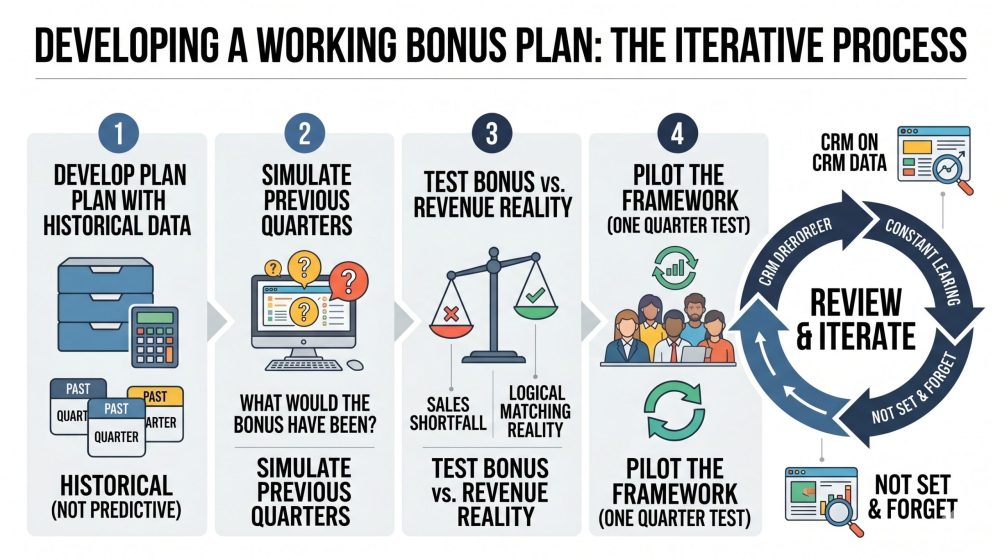
To go from a theoretical performance-based bonus plan to a working compensation plan requires attention to detail.
If you announce a flawed plan and then retract it one month later, you will lose the respect of the employees.
To reduce this risk, the following steps should be followed in developing and launching a bonus plan that rewards employees for their efforts.
Develop and test an actual bonus plan using historical data
Never launch a bonus plan based solely on predictive data.
You must test your proposed formula by using actual data from the previous two quarters of your company.
As you develop your model, ask yourself, "What would the bonus have been last quarter had this model been in use?" And, "Does the actual performance match what the model would have generated?"
If you create a model where a person receives a large bonus for a quarter in which the company's total sales were short of its revenue target, it means that the model does not appropriately reflect the business.
Test the bonus plan for one quarter
As a best practice, you should tell your employee that you are piloting the framework to ensure it is a fair and accurate representation of the business.
By testing the framework, you will learn how it works, and you will have a way to address any issues if they arise.
Review and analyze the metrics
After you perform your initial test, evaluate how well the plan works to promote the desired behaviors in your employee.
The metrics used by the CRM should accurately reflect the data being collected, without requiring manual intervention.
If there was too much messiness in the attribution for that quarter, try and keep the next quarter's metrics simple.
There is a constant learning curve when designing compensation for employees in a start-up environment; it’s an iterative process, not just a ‘set it and forget’ approach.
What should not be paid on?
Ultimately, it is just as important to know what metrics you will not pay on as it is to know what metrics you will pay on.
Several metrics are considered to be toxic by almost every early marketing team.
Revenue without sales touch
Unless your company has a PLG motion and no sales team, never base marketing bonuses entirely on closed-won revenue.
Marketing cannot make prospects sign contracts; therefore, placing full responsibility for the eventual close on marketing causes resentment toward sales.
Vanity metrics
You should never base bonuses on social media followers, website impressions, or raw open rate numbers.
The numbers are easily manipulated, and do not typically correlate to real business growth.
By paying on vanity metrics, you teach marketers to optimise for optics versus commercial impact.
Hustle metrics
Bonuses based on subjective criteria, such as “teamwork,” “effort,” or “going above and beyond” are not performance bonuses; they are discretionary bonuses.
Subjectively based bonus plans create a culture of favouritism, and possibly bias.
If an outcome cannot be measured and documented, it should not form a part of the official bonus plan.
Conclusion
Developing compensation for the early marketing team is an exercise in dealing with uncertainty; there is no such thing as perfect attribution for teams like marketing or sales, and direct management of revenue is a myth as well.
Great founders often realize that the quest for a perfect mathematical incentive plan is futile and choose instead to create a compensation system that is transparent and aligned with cash constraints and heavily weighted to the types of goals that marketers can impact directly.
A properly functioning bonus system does not need to be complicated; it simply needs to drive focus, recognize the contribution being made by an individual employee, and maintain the long-term financial health of the organization.
The key is to create a solid foundation, develop strict guardrails that govern how the mechanics work, and make adjustments as the organization increases in data maturity.
Common questions
What if our CRM attribution is completely broken?
When you can't trust the data you have, you should stop using individual performance metrics immediately.
You should shift to a combined compensation model based on overall company revenue and some type of measurable deliverable-based MBO.
Fix broken operational tracking before trying to implement a complex pipeline incentive program.
Should we pay a lower base salary for a higher bonus incentive target?
No.
High-variable compensation should only be paid to job functions with direct control of closing revenue in the near term, such as account executives.
A marketing hire will expect to receive a stable base salary that is consistent with industry standards, and the bonus should be used to accelerate exceptional performance, not serve as a substitute for a living wage.
A typical structure for early-stage start-up marketing role compensation would be 80 to 90 percent of base to 10 to 20 percent of bonus.
What do we do about bonuses if our sales team doesn't close high-quality pipeline?
This is why marketing bonuses should be heavily weighted towards qualified pipeline or "Sales Accepted Leads" gained, versus only closure; when the marketing team produces the agreed-upon quality and quantity of pipeline, they have done their jobs and deserve the compensation they receive.
If the sales team does not close, this indicates an execution problem in the sales team, pricing problem, or product issue — none of which the marketer has any control over.
Can we include clawbacks to the marketing bonus program?
While clawbacks are pervasive in sales and are most commonly attributable to deals that churn shortly after closing, clawbacks are seldom used and often ineffective within marketing roles, since marketing typically operates earlier in the funnel.
Penalizing the marketing department through clawbacks for downstream churn creates significant administrative overhead and erodes trust.
Quality of the pipeline is managed through initial qualification criteria, not retroactive clawbacks.
