
The majority of Digital Scale Playbooks are not designed to meet the needs of every online marketer.
They focus solely on creating a dream without discussing the reality of performing those tasks.
As a result, companies spend months trying to put online marketing tactics together without a strategy built into their organizations to grow and thrive.
There is no magic when it comes to growth.
It requires a systematic approach with specific roles, timelines, and a willingness to change direction quickly when data points indicate decline.
This report will provide an understanding of all the operations and processes and a step-by-step guide to growing a digital asset from being stagnant to a vehicle that grows consistently and predictably.
We will provide the specific metrics that can be measured and the things that should be done to get there.
A plan to achieve results within 90-days of launch
The speed of growth is critical for a company to be successful in the digital marketing space.
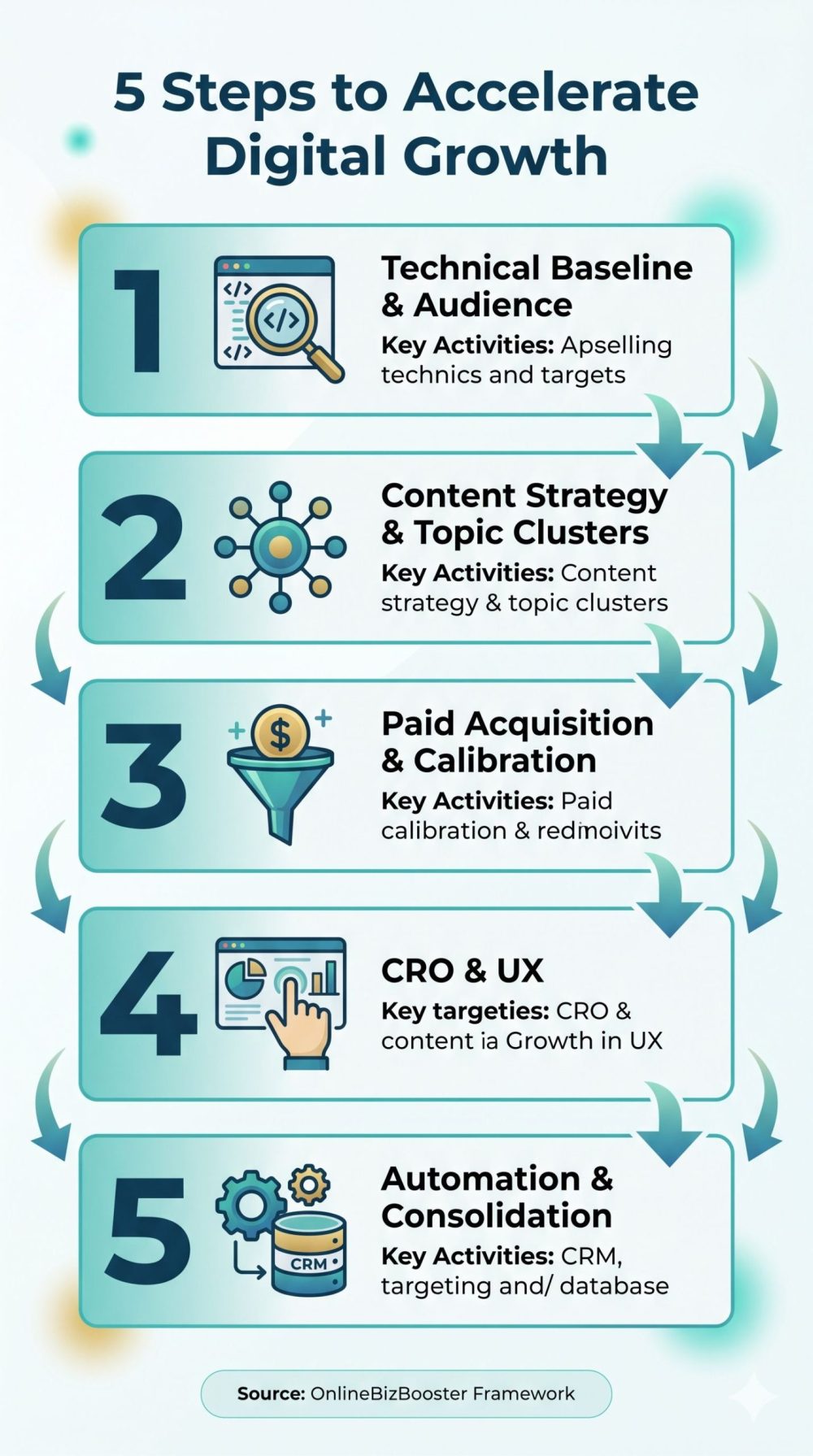
Teams must know exactly what actions will occur and the expected time frame of those actions throughout the first 90-days of launching any type of digital marketing channel.
Days 1 - 15: Baseline and discovery
The technical audit process is the primary focus of this period. A business cannot grow from a leaky bucket.
During this audit period tracking errors should be fixed, GA4 Event Tags properly configured, and the Customer Acquisition Cost (CAC) Thresholds identified to enable marketing awareness of their audience's intention to search for the business.
Days 16 - 45: Content and acquisition infrastructure
During this time period, each piece of content published should be based on topical authority instead of isolated keywords.
Content that is published or promoted within Meta or Google Ads should be created to acquire data for the business rather than to make a profit from the ads immediately.
In addition, during this time period, create Standard Operating Procedures (SOPs) for Content Teams and work with your team to establish these SOPs to create the content.
Days 46 - 75: Conversion rate optimization and user experience
The data from Days 1 through 45 guides the changes made at this stage. Heat maps and recorded interactions identify points of friction.
Split-testing on primary landing pages uses expected conversion delta ranges of 8 to 22% based on your industry field.
Days 76 - 90: Automated scalable workflows
Manual workflows are now turned into automated sequences. Email nurtured flows are completed and tech stacks consolidated.
Then, successful ad creatives begin to be vertically scaled. In addition, cross-team collaborations between product managers, marketing teams, and engineers are formalized to prepare for the next round of growth.
The failure of standard growth advice under pressure
If you do a quick review of the literature in your industry, you’ll see a big problem.
Almost all of it fails to provide verifiable results (i.e., 'before and after' metrics) that are related to the framework used.
Many provide general five-step lists for increasing revenue without providing evidence.
Furthermore, they are not relevant to small teams or solo founders who have to try to execute with limited time available to them. In contrast, real growth frameworks provide you with specific workflows and include things such as timetables, estimated resources, and task ownership.
Without a clear understanding of tradeoffs, i.e., when a step backfires, or when the costs outweigh the advantages, all strategies are theoretical.
Execution costs ultimately determine which systems can be put into action, how many people are needed to implement each step, how many hours to implement, and how many dollars from their budget will be needed for each step.
Step 1: Understanding your audience(s) and creating a technical baseline
To begin with, you need to know your audience(s) and your business intent. However, creating an audience without a proper technical baseline will only be wasted time and resources.
If a website has issues with indexability, has slow loading speeds, or has faulty event-tracking, all the efforts that go into downstream marketing will only waste money.
The purpose of this step is to eliminate blind spots, and create an error-free tracking environment, along with identifying the specific buyer personas that drive revenue for your business.
Required inputs
- Existing Customer Data.
- Google Search Console.
- GA4.
- Technical SEO Crawlers (e.g., Screaming Frog or Sitebulb).
Expected outputs
The outputs from this stage will include an Ordered List of Technical Items that Need to Be Fixed, a Verified Tracking Dashboard, and Three Core Buyer Persona Profiles with Mapped Search Intent.
Execution tasks
- Conduct a Website Audit on CWV and Fix any issues that exist with LCP or CLS.
- Configure Server-Side Tagging if Privacy Blockers are Preventing Data Collection.
- Interview 5-10 Recent Customers to Gather Exact Phrasing to Use for Copywriting.
- Time Estimate: 15-20 Hours of Focused Engineering and Analytics Work.
- Lead Owner: Technical SEO Lead/Growth Manager.
Step 2: Developing a content strategy and topic clustering
The publishing of blog posts at random will guarantee that you become lost in obscurity.
Search engines will reward you with organic traffic when you structure and interlink your information into well-developed content strategies.
Moving forward, you must change direction and focus on developing deep Topic Authority by building Topic Clusters, rather than chasing massive keyword volumes that will never rank.
The purpose of this step is to capture high intent organic traffic by developing deep coverage of a single subject better than any of your competitors can.
Required inputs
- Existing Market/Gap Analysis of Competitors.
- Keyword Clustering Software.
- Customer Support Ticket History (for Long-Tail Queries).
Expected outputs
The output of this stage will include a 6-Month Editorial Calendar, Strict Content Brief Templates, and An Internal Linking Map.
Execution tasks
Create a Hub-and-Spoke Content Architecture.
The pillar page will provide a broad overview of your target overall topic, but your cluster pages will provide answers to very specific and often niche questions related to your target overall topic.
To create a comprehensive content brief, you must identify each semantic entity you wish to address and the total word count that will be required, as well as what internal links are required in that content brief.
Signal E-E-A-T (Experience, Expertise, Authority, Trustworthiness) by having authors clearly named, in addition to citing primary data.
Estimated Time to Create a Comprehensive Content Brief: 90 Minutes.
Total Time of Strategy Creation: 30 Hours.
Owner of the Content Strategy: Content Strategy and Managing Editor.
Step 3: Paid acquisition and funnel calibration
While organic traffic can be very profitable, it takes time to generate.
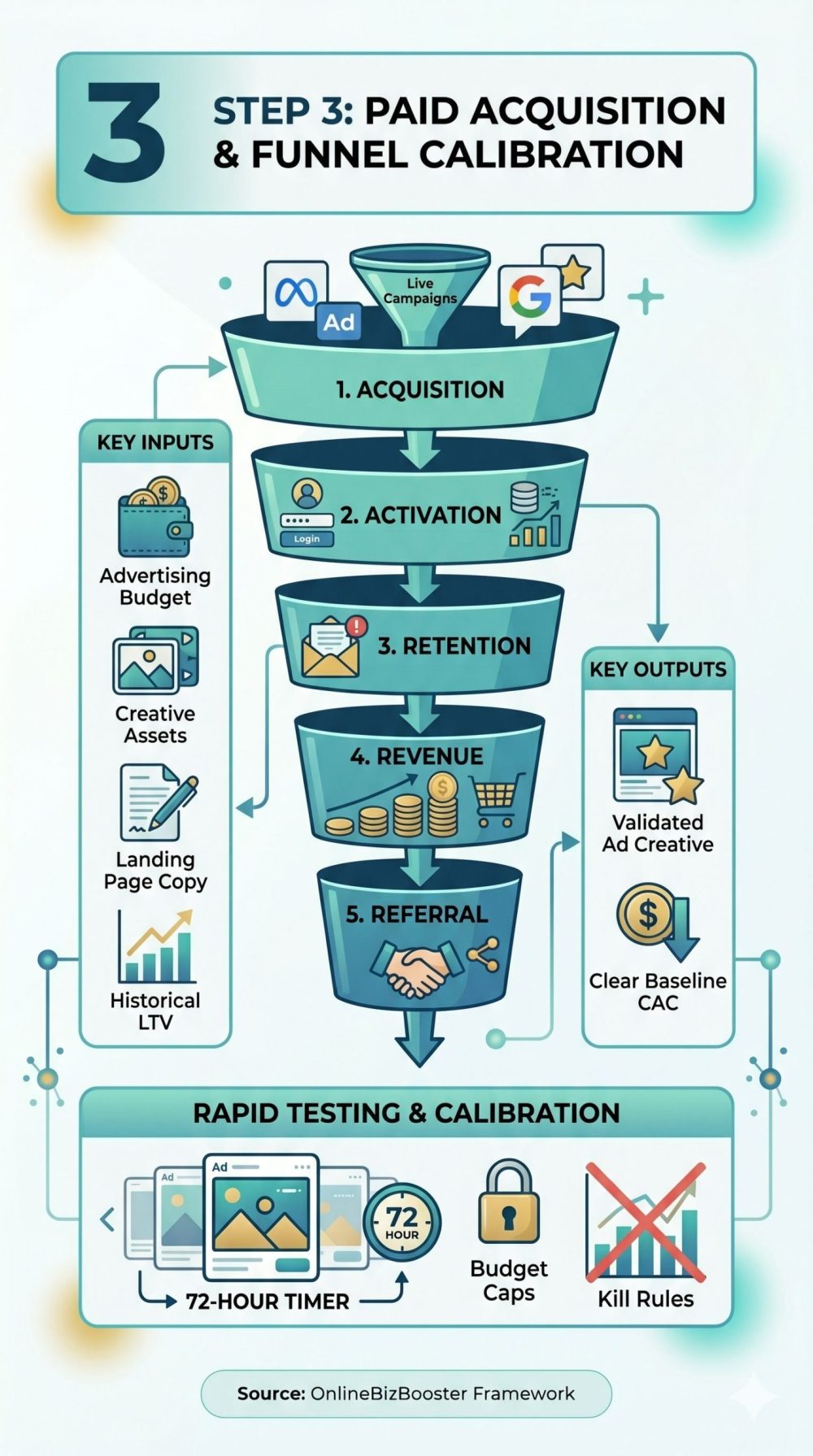
The benefit of paid acquisition is that you purchase both speed and critical behavioral data.
Thus, this phase of your customer journey relies heavily upon the AARRR Funnel Logic (Acquisition, Activation, Retention, Revenue, and Referral) beginning with a primary emphasis on efficient acquisition.
Purpose: To quickly validate messaging and offers through the use of paid acquisition channels while keeping close control over customer acquisition costs.
Required inputs
Advertising budget, creative assets, landing page copy, and historical LTV (Life Time Value).
Expected outputs
Live Campaigns, Validated Ad Creative, and a Clear Baseline CAC.
Execution tasks
Launch Rapid Testing Phases on either Meta or Google Ads with Creative Rotation every 72 hours once a winning combination has been determined.
Map out User Experience/Journey from Click to Checkout; continue to ensure your messaging matches at various stages within your funnel.
Establish Budget Caps and Kill Rules to identify underperforming ad sets.
Estimated Time to Launch Paid Campaigns: 10 Hours for Initial Set-Up; 3–5 Hours Per Week for Continued Calibration.
Owner of Paid Campaigns: Performance Marketing Specialist.
Step 4: Conversion Rate Optimization (CRO) & UX
Traffic is not significant; only the number of conversions is significant.
Once you have established a consistent flow of users on the website, your priority becomes creating as much frictionless experience through the conversion process as possible.
CRO is not just tweaking your design randomly; it is a systematic and iterative process that takes a scientific approach.
The purpose of CRO is to maximize your site's revenue potential by conducting systematic experiments with different variations of copy, layout, and user flows for the same traffic they use to land on your site.
Required inputs
Examples of input for CRO include heat maps, session recordings, drop-off reports in Google Analytics, and/or A/B testing platforms.
Expected outputs
The output from those inputs will be the test hypotheses that were documented and the winning design(s) that improved conversion rates.
Execution tasks
Use your Analytics data to identify the pages with the highest traffic and lowest conversion rate so you can focus on testing the pages that will have the most impact.
Write a hypothesis that specifies what will happen with the conversion rate if you make an easy-to-implement change to that page.
An example of this would be: "If you move the primary CTA to above the fold, your form fills will increase by 12%."
Once you have your hypothesis, test until you reach statistical significance, document your results, and implement the change that test showed was the winner of that test.
Time to complete each test cycle (set up / review data) = 5 hours.
Ownership of this process = CRO Specialist / UX Designer.
Step 5: Automation and tech stack consolidation
If you don't automate your proven tactics, your manual processes will break when you scale your company.
So, once you've achieved some level of initial traction, then you need to automate the proven tactics, which means integrating all the tools you use together so that the data flows easily from your CRM to your Marketing Automation / Email Service Provider to Your Product.
The purpose for Automation & Consolidating your Tech Stack is to reduce your operational costs and to maximize the customer's lifetime value through automated processes that utilize retention loops and referral loops.
Required inputs
The inputs for Automation & Consolidating your Tech Stack are validated email copy, CRM data, and user behavior triggers.
Expected outputs
The outputs for the Automation & Consolidating Tech Stack process are: Automated email nurture sequences, integrated data pipelines, and a streamlined technology stack.
Execution tasks
Building email triggers based on certain behaviors (e.g., abandoned cart sequences; onboarding flows).
Conduct an audit of your current Technology stack to eliminate any redundant software in your stack and to help you reduce your monthly operational costs.
Building automated reporting systems.
Estimated Time Commitment: 25 to 40 hours for a complex CRM and automation setup.
Responsible Party: Marketing Operations Lead.
Realities of execution costs and resources
Strategic frameworks often overlook a crucial aspect of business operations: the limits on resources.
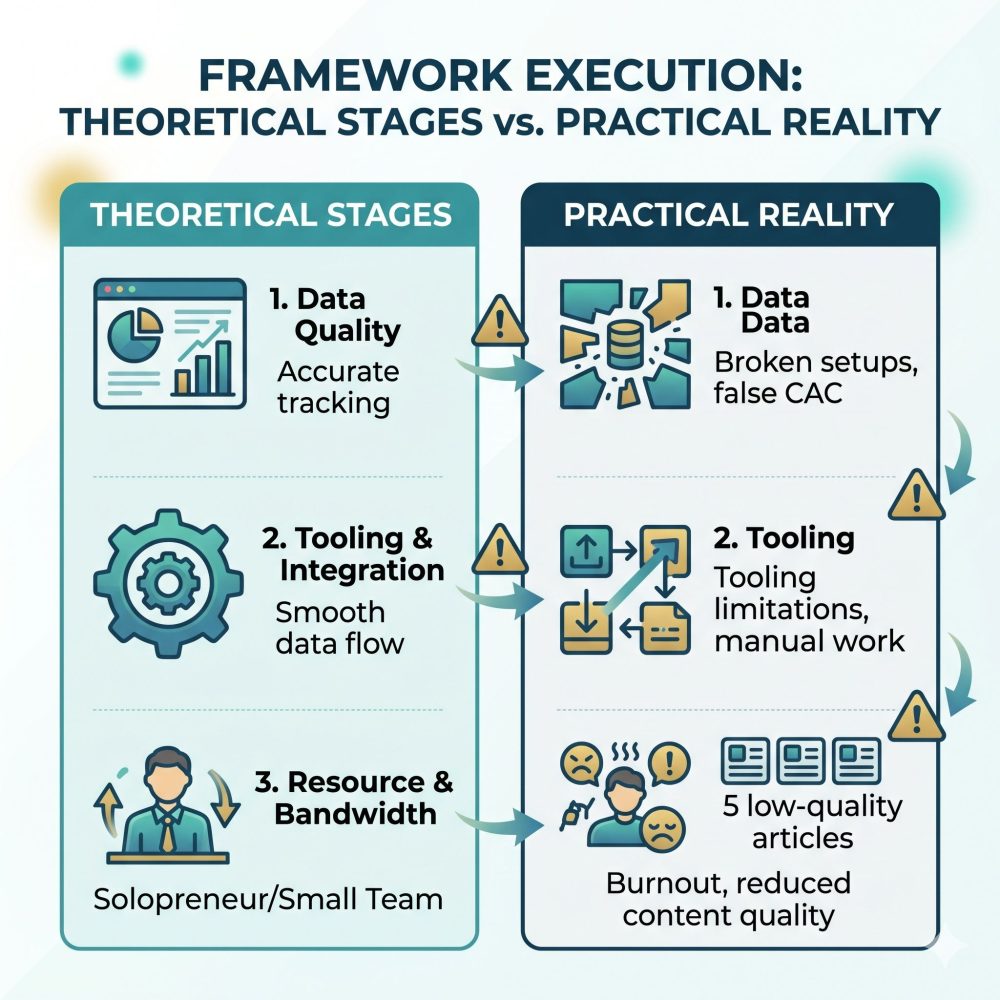
Understanding the theoretical stages is one thing, but having the right funding and staffing to carry them out is another. Small teams encounter immediate challenges.
Trying to address all five steps at once with just two people can lead to quick burnout without producing any significant results.
Proper resource allocation necessitates tough prioritization.
The foundational technical requirements demand substantial engineering expertise, which might need external contractors if in-house skills in technical SEO or analytics are lacking.
Time-to-impact plays an essential role in decision-making.
Users contemplating whether to purchase a course, recruit a consultant, or follow a DIY guide are concerned about realistic timelines.
Technical solutions and paid advertising can yield measurable outcomes within 30 days, while content strategies aimed at building organic authority typically take between 90 to 180 days before delivering sustainable benefits.
Leadership needs to align its expectations with these realities to prevent prematurely halting long-term projects.
Budget allocation hinges on risk versus ROI considerations. Paid platforms provide instant spikes in activity but require ongoing financial investment.
Conversely, organic approaches necessitate considerable initial investments in both talent and time but result in cumulative returns that last for years.
Effectively balancing this portfolio is primarily the responsibility of the growth lead.
Practical challenges: When frameworks fall short
Competitors seldom acknowledge their shortcomings publicly; instead, they promote their frameworks as guaranteed solutions applicable across all scenarios.
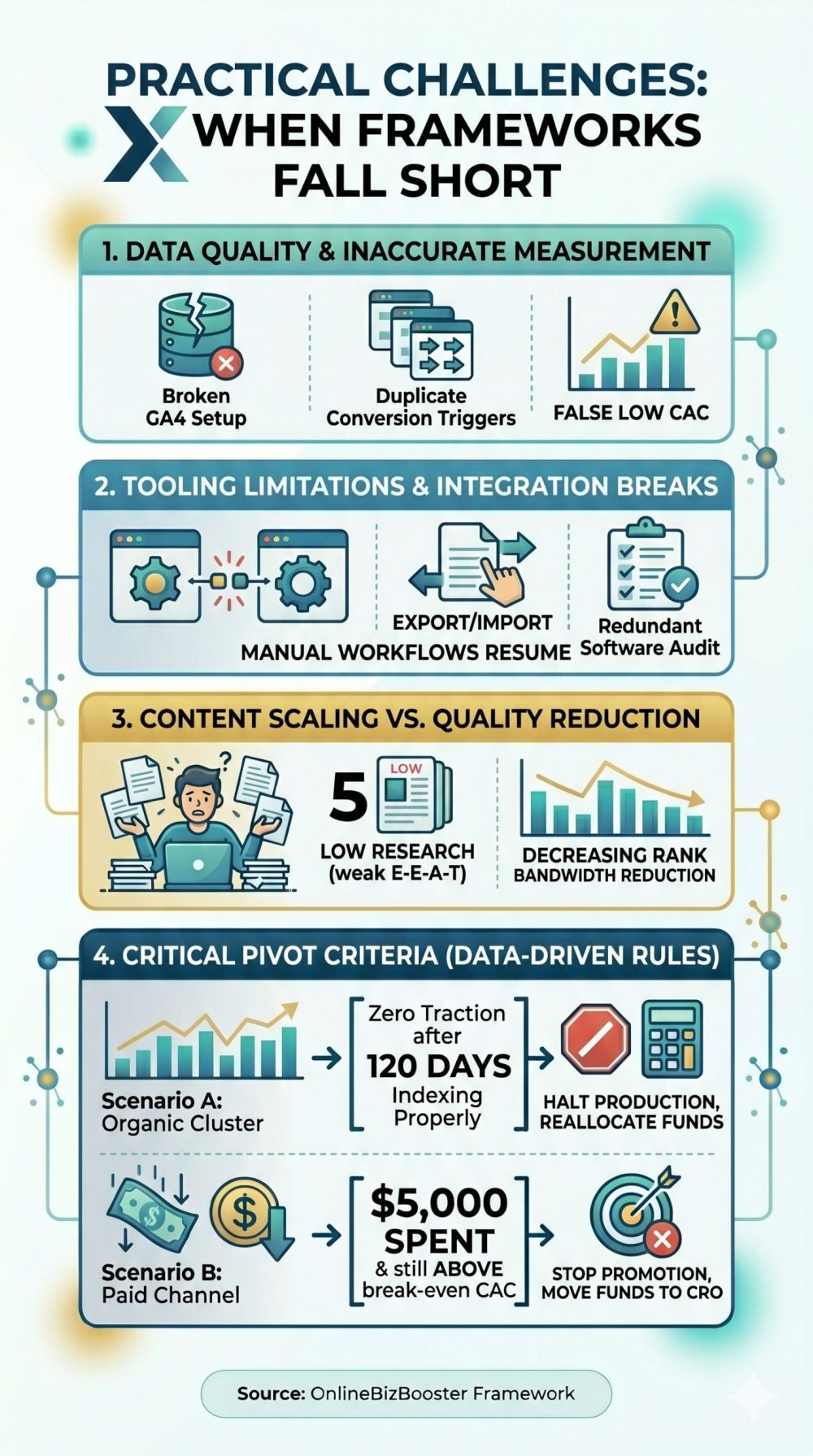
This notion is flawed from both mathematical and operational standpoints—frameworks tend to fail under specific circumstances quite predictably.
Recognizing the critical points of failure within a process is what allows a startup to take corrective action before its funds run out.
Understanding where data quality fails
If the baseline data is not truly established, then the foundation for decision making is also broken and the entire system will fail.
If you build campaigns with bad GA4 setups or with conversion pixel tracking that is tracking conversions twice, then it is likely that one day, when doing your budgeting, you will allocate money incorrectly.
When a company's CAC is unnaturally low, then most of the time it will be the result of broken tracking.
Tooling limitations and integration issues
Many startups have poor tools in place for the creation and implementation of their SaaS product. Often, the tools lack the ability to integrate.
When the marketing automation tool cannot pull the product usage data from the application's database due to the inability of the application to send the data, then the automation step fails.
Therefore, if you were relying on that automation for the efficiency of your processes, you now must manually export data.
Quality of content and bandwidth reduction within the team
As content production scales, the majority of production will fall below acceptable standards.
Especially if the content owner has to produce five articles a week, and all of them are done without much research done on them, the company will be decreasing the company's ability to rank.
The company should have produced two highly researched article types to create E-E-A-T signals.
Reasons or criteria for pivots
When there is failure to produce something within your organization, it will be necessary to pivot very quickly and with little hesitation.
If a cluster of organic content continues to experience zero traction after 120 days of being indexed properly, then halt production on that cluster to reallocate funds toward more proven long-tail topics.
If a paid channel has not surpassed break-even CAC after spending $5,000 between various creative rotations, stop promoting that channel and reallocate the funds towards Conversion Rate Optimization.
Theoretical and real-world examples
The theory and case studies demonstrating how the above model can be applied to real-world operations provide more evidence for understanding how the above steps apply to operations over the last 10 years.
Case study 1: Soloentrepreneurs go from 0 users to 1,000 users
The Context: A SaaS entrepreneur who was at the beginning stages of development needed to develop a system for acquiring their first 1,000 active users within 60 days with a strict budget of $3,000.
The Friction: No brand authority and limited capacity to create massive content cluster pages.
The Action: Instead of following Step 2 (creating deep content), the entrepreneur focused on Steps 1, 3, and 4 only.
They created a clear Google Analytics 4 (GA4) tracking system during week one. After setting up a proper GA4 tracking system, they invested the entire $3,000 into targeted LinkedIn ads that directed users to a single, high-converting landing page.
The Numbers: Initial Traffic: 50 visitors/month. Traffic by Day 60: 3,200 visitors/month. Conversion Rate Stabilization: 8.5% after three rounds of rapid A/B testing for Conversion Rate Optimization (CRO). Outcome: Added 272 new users. Change of Strategy: CAC was so high that it couldn't be sustained, so the entrepreneur had to make a shift to creating content organically for the next 90 days.
Case study 2: B2B agency increasing organic traffic stagnation
- The Context: A 15-person marketing agency experienced a 40% reduction in inbound leads year over year. They needed to develop a repeatable system to scale organic traffic through their core services.
- The Friction: The current content on their website was thin. There were no named authors for any of the articles, nor were there any author credentials. There were also no examples to support the content.
- The Action: The agency focused heavily on Step 2. They deleted or consolidated 40% of all of the company’s old blog posts.
- Content briefs were extremely detailed with the following information: precise resource estimates, proven results from the client and the dates/timestamps for new articles. E-E-A-T was the core concept.
- Metrics: Initial drop: -12% in organic traffic during the content pruning process. 4th month recovery: Exceeded its previous highs by +140% traffic increase.
- Quality of leads: Improved by +65% MQLs from the authoritative and in-depth nature of the topic clusters.
- Outcome: Rebuilt a sustainable inbound marketing strategy to create ongoing momentum without requiring any paid advertising.
Conclusion
Growth is only possible if creativity is coupled with disciplined operations.
The internet is full of unspecific, repetitive advice, and excessive amounts of non-original content.
Success cannot happen without a significant shift toward E-E-A-T, superior technical execution, and consistent measurement.
Frameworks are just frameworks; the true value lies in rapid iterations of both inputs and outputs and continually optimizing the user experience.
It is only by concentrating on concrete inputs and outputs with strict accountability across the five core components that teams can remove the distractions and build scalable, repeatable digital momentum.
Frequently Asked Questions (FAQs)
How long will it take to see results with this digital growth model?
The timelines vary greatly depending on the channel used. Technical SEO implementation can produce measurable traffic and conversion statistics within 14 to 30 days.
However, content clusters that establish authority will take 90 to 180 days to demonstrate sustainable traffic increases. Massive organic spikes in week two are not possible logically.
Do we need a larger team to properly implement this framework?
No, but you will need to prioritize ruthlessly. A solo entrepreneur or a team of three cannot implement the five steps simultaneously.
Small teams will need to sequence their use of the framework.
They will first establish their technical foundation, select one primary channel of acquisition (paid or organic, but not both simultaneously), and automate as much as possible to maximize efficiency.
How does this differ from traditional AARRR funnels?
The AARRR funnel is a general conceptual framework for understanding the stages of user behaviour.
This framework is a practical system of actually implementing AARRR principles, especially when transitioning from the third stage (Acquisition) to the fifth stage (Retention and Automation).
It focuses solely on resourcing, ownership of tasks, and timeline estimates needed to actually build out a sales funnel.
What is the main reason for failure during implementation?
Ignoring or overlooking the technical foundation outlined in Step 1.
Teams tend to want to rush to launch campaigns and publish new content to promote their organization, failing to check the web site's technical structure and confirming their analytics are correctly tracking data points.
Traffic to a poorly constructed site that fails Core Web Vitals and/or reports inaccurate conversions will result in the immediate depletion of the budget and lead to very poor and notable decisions based on false data.
