
Entrepreneurship has traditionally been associated with individuals developing their own ideas, creating new brands and taking responsibility for every aspect of building a business.
However, the growth of franchising has introduced an alternative route into business ownership.
Instead of creating an organisation entirely from the ground up, entrepreneurs can operate within an established business model while retaining ownership of their individual outlet or operation.
This raises an important question: is the growing popularity of franchising gradually replacing traditional entrepreneurship, or is it simply creating another way for people to become entrepreneurs?
The growing appeal of franchising
For many aspiring business owners, franchising offers a balance between independence and structure.
A prospective owner searching for a franchise opportunity may be attracted by the established brand, operating procedures, training, marketing resources and support provided by the franchisor.
This can make the process of entering business ownership appear more manageable than developing an entirely new concept.
Research has found that franchised businesses can have higher survival rates than independent businesses, although the advantage is relatively small and tends to diminish after the first few years.
The research also suggests that brand recognition and business know-how provided by franchisors contribute to this initial advantage.
This does not necessarily mean that traditional entrepreneurship is disappearing.
Instead, it suggests that people are becoming more open to different approaches to business ownership.
Traditional entrepreneurship offers greater freedom
One of the defining characteristics of traditional entrepreneurship is autonomy.
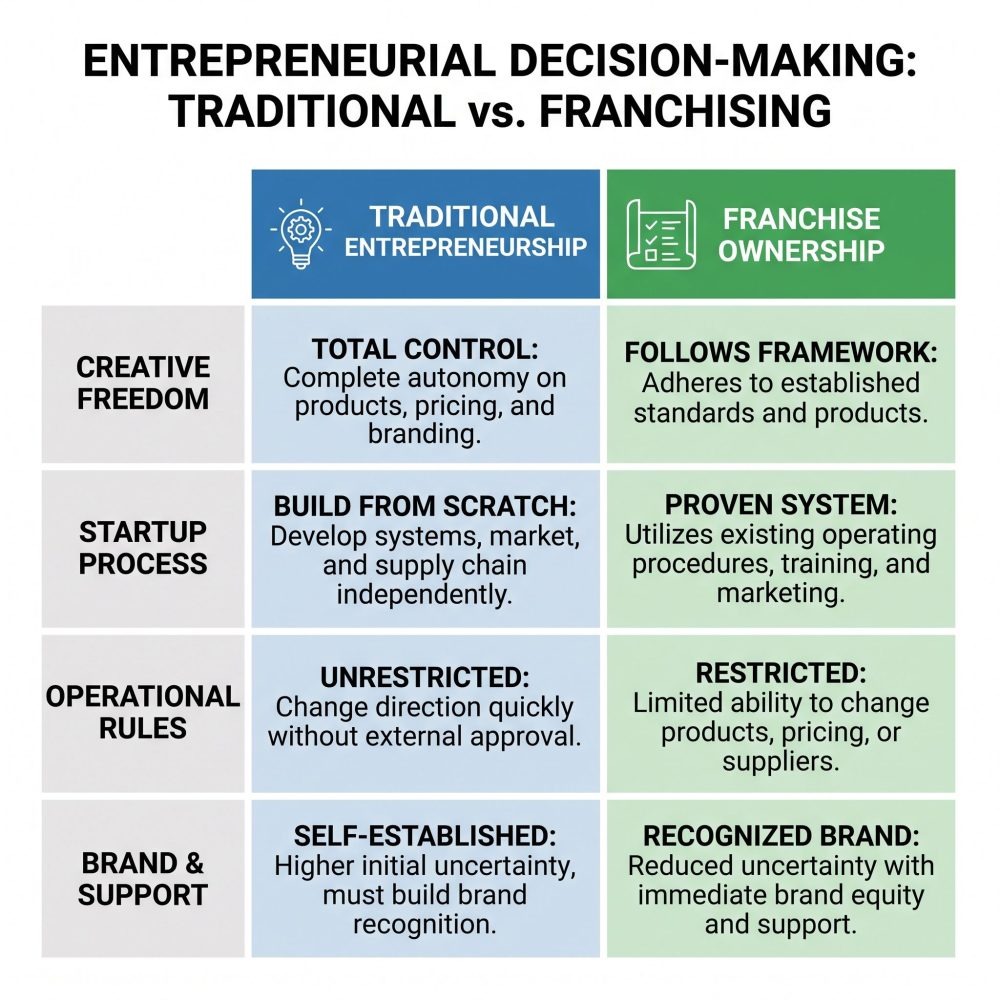
An independent entrepreneur can decide what products to sell, how to market them, which suppliers to use and how to position the company.
They can change direction quickly when opportunities arise without necessarily needing approval from another organisation.
This freedom is particularly important for individuals who want to build something completely unique.
An independent business can be based on a personal idea, specialist expertise or innovative concept that may not fit within an existing franchise system.
Franchising, by comparison, requires franchisees to follow established standards.
Academic research has identified entrepreneurial autonomy as an ongoing challenge within franchise relationships because franchisees must balance their own entrepreneurial behaviour with the franchisor's need for consistency and control.
Franchising can still be entrepreneurship
It would therefore be misleading to suggest that franchisees are not entrepreneurs.
They still invest capital, manage employees, deal with customers, make operational decisions and accept the financial risks associated with running a business.
Academic research has specifically examined franchising as part of entrepreneurship, recognising the roles played by both franchisors and franchisees.
Franchisees can bring an established concept into new markets and make decisions that influence the performance of their individual businesses.
The distinction is that franchise entrepreneurship operates within a framework.
Rather than having complete creative freedom, the entrepreneur works with an established concept.
For some people, this is not a disadvantage but a practical way to combine business ownership with access to proven resources.
Why some entrepreneurs prefer the franchise model
Starting an independent company can involve considerable uncertainty.
Entrepreneurs need to establish a brand, develop systems, understand their target market and determine which strategies will attract customers.
Failure to find the right combination of products, pricing and marketing can have serious consequences.
Franchising can reduce some of this uncertainty by providing a tested framework.
The franchisor may already have established suppliers, operational procedures, marketing strategies and customer expectations.
Entrepreneurs who have confidence in their management abilities but do not want to develop every element of a company themselves may therefore find franchising particularly attractive.
Research into entrepreneurial decision-making has also found that individuals choose franchising for reasons connected to the risks, resources and characteristics of independent business ownership.
The limitations of the franchise approach
The benefits of franchising come with trade-offs. Franchisees generally pay fees and agree to operate according to the terms of a franchise agreement.
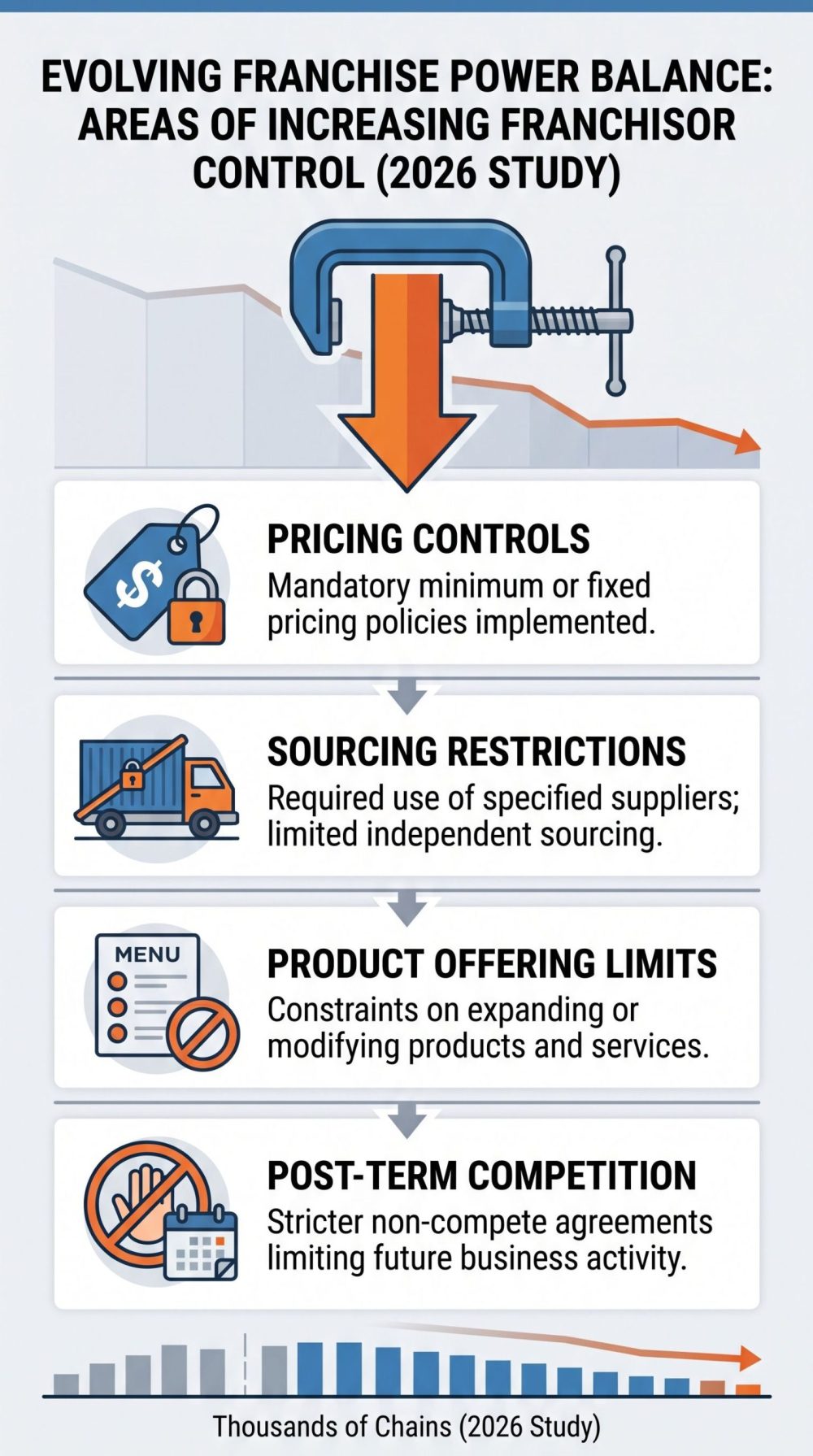
Their ability to change products, pricing, branding, suppliers or operating procedures may therefore be restricted.
This can create frustration for entrepreneurs who want complete control over their businesses.
Research examining franchise relationships has highlighted tensions between the franchisor's desire for standardisation and the franchisee's desire for autonomy.
Recent research has also drawn attention to changes in the balance of power between franchisors and franchisees.
A 2026 study examining thousands of franchise chains reported increasing restrictions in areas such as pricing, sourcing, product offerings and post-term competition.
Consequently, prospective franchisees need to understand that they are buying into a business system, not simply purchasing the right to use a brand name.
Technology is creating more choices
Technology is also changing the relationship between franchising and traditional entrepreneurship.
Digital platforms, e-commerce tools, social media and accessible business software have reduced some of the barriers that previously made independent business ownership difficult.
An entrepreneur can now launch a specialist service, sell products online and reach customers through digital marketing without necessarily requiring the infrastructure associated with a traditional physical business.
At the same time, franchise businesses can use the same technologies to strengthen their marketing, customer service and operational systems.
Rather than one model replacing another, technology is arguably expanding the range of options available to entrepreneurs.
The two models can coexist
The continued growth of franchising does not necessarily indicate the decline of traditional entrepreneurship. In reality, the two models serve different preferences.
Some entrepreneurs are motivated by innovation, independence and the opportunity to create an original brand.
Others value structure, established systems and the support associated with an existing organisation.
Franchising can also provide a pathway for people who might otherwise be reluctant to start a business.
It can introduce them to management, leadership and commercial decision-making while giving them access to a recognised framework.
At the same time, successful franchisees may eventually develop multiple locations or businesses, demonstrating that franchising can become a platform for entrepreneurial growth rather than an alternative to entrepreneurship.
The road ahead
The franchising model is unlikely to completely phase out traditional entrepreneurship. Instead, it is expanding the definition of what business ownership can look like.
Franchising provides a structured approach that can appeal to people who want to become entrepreneurs without developing every part of a business from scratch, while independent entrepreneurship continues to attract those who value innovation and complete control.
Ultimately, neither model is universally better. The right choice depends on an individual's ambitions, resources, appetite for risk and preferred level of independence.
The growing popularity of franchising should therefore be viewed less as the replacement of traditional entrepreneurship and more as evidence that modern entrepreneurs have an increasingly diverse range of ways to build and own businesses.
