
Operational efficiency remains a core objective for organizations seeking long-term sustainability and market relevance.
In competitive environments, hidden inefficiencies often erode profit margins and consume valuable resources without adding tangible value for the end customer.
Systematically addressing these inefficiencies requires a structured approach to process analysis, clear definitions of value, and a commitment to continuous improvement.
Understanding the nature of operational waste is the first step toward transforming underperforming workflows into streamlined, high-performing systems.
Defining waste in the modern enterprise
Within business operations, waste encompasses any activity, resource allocation, or process step that consumes time, energy, or money without contributing to the final product or service as perceived by the customer.
Traditionally categorized into specific areas of excess, waste manifests differently across administrative, manufacturing, and service sectors.
Recognizing these manifestations demands objective observation and rigorous data collection rather than reliance on subjective assumptions.
When teams learn to view daily operations through the lens of value creation, systemic bottlenecks immediately become apparent.
Traditional frameworks categorize operational inefficiencies into distinct types, each representing a specific drain on resources.
Identifying these categories allows organizations to target their improvement initiatives effectively.
By systematically reviewing workflows, leaders can isolate the root causes of delay, redundancy, and unnecessary expenditure.
The core categories of operational inefficiency
To effectively reduce waste, one must first be able to name and classify it.
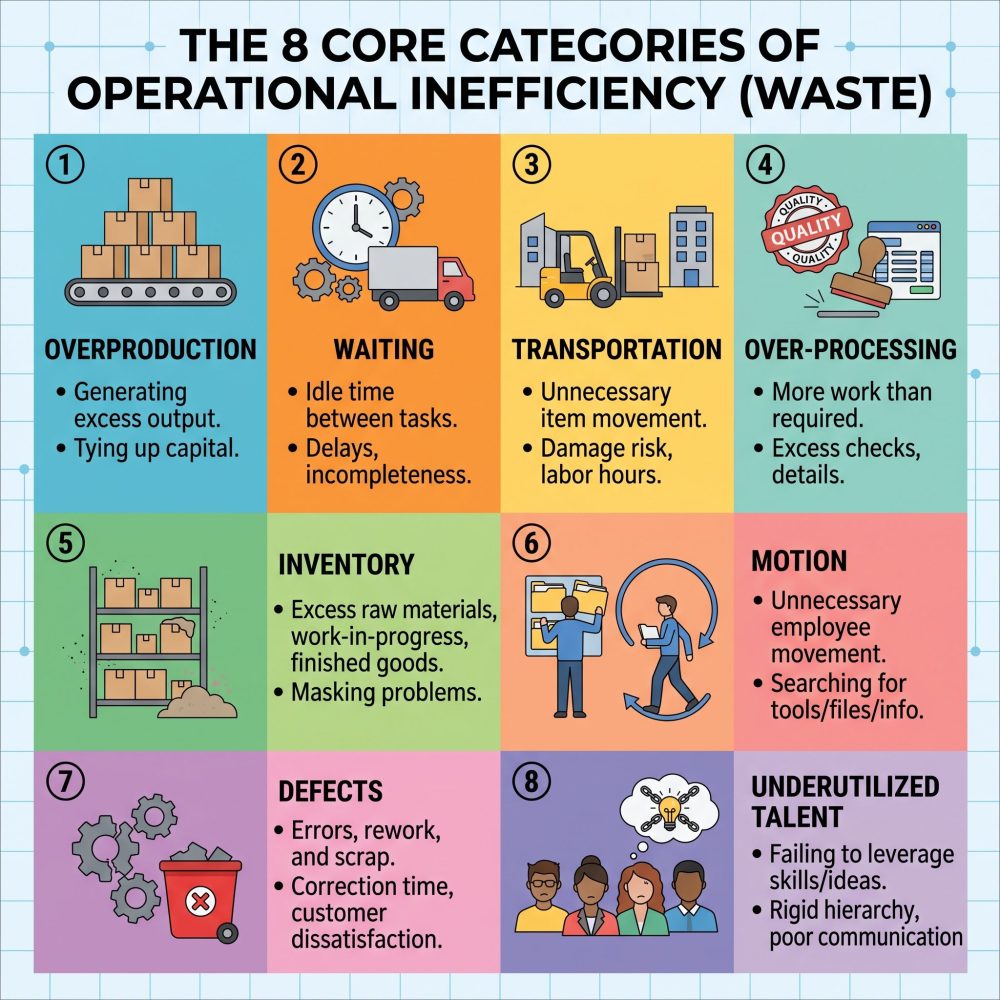
The most prevalent forms of inefficiency observed in corporate environments include:
- Overproduction: Generating more output than is currently required by downstream processes or actual market demand, tying up working capital and storage space.
- Waiting: Idle time occurring when dependent tasks cannot proceed because preceding steps are delayed, incomplete, or unavailable.
- Transportation: Unnecessary movement of materials, documents, or information between locations, which increases the risk of damage and consumes labor hours.
- Over-processing: Performing more work, detail, or quality checks than the customer actually requires or is willing to pay for.
- Inventory: Holding excess raw materials, work-in-progress, or finished goods beyond immediate processing needs, which masks operational problems.
- Motion: Unnecessary physical movement by employees during their daily tasks, such as searching for tools, files, or information due to poor workspace organization.
- Defects: Errors, rework, and scrap that require correction, leading to wasted time, customer dissatisfaction, and increased operational costs.
- Underutilized Talent: Failing to leverage the skills, ideas, and creative potential of employees, often due to rigid hierarchical structures and poor communication.
Addressing these categories requires active engagement from all levels of the workforce.
Frontline employees often hold the deepest practical knowledge of where daily friction occurs, making their involvement essential for accurate diagnosis.
Mapping the current state of operations
Before implementing any reduction strategies, organizations must document their existing workflows through comprehensive process mapping.
This visual representation details every step, decision point, and handoff involved in delivering a product or service.
Mapping highlights the ratio of value-adding activities to non-value-adding activities, providing a clear baseline for future improvements.
During this phase, cross-functional collaboration is vital to ensure that all perspectives are captured accurately, as departmental silos often distort the true picture of end-to-end delivery.
Once the current state is mapped, teams analyze the data to distinguish between necessary non-value-adding activities—such as regulatory compliance checks—and pure waste that should be eliminated entirely.
This analytical rigor prevents well-intentioned changes from disrupting critical compliance or safety protocols.
Implementing targeted reduction strategies
Eliminating identified inefficiencies demands a methodical strategy that balances quick wins with long-term structural changes.
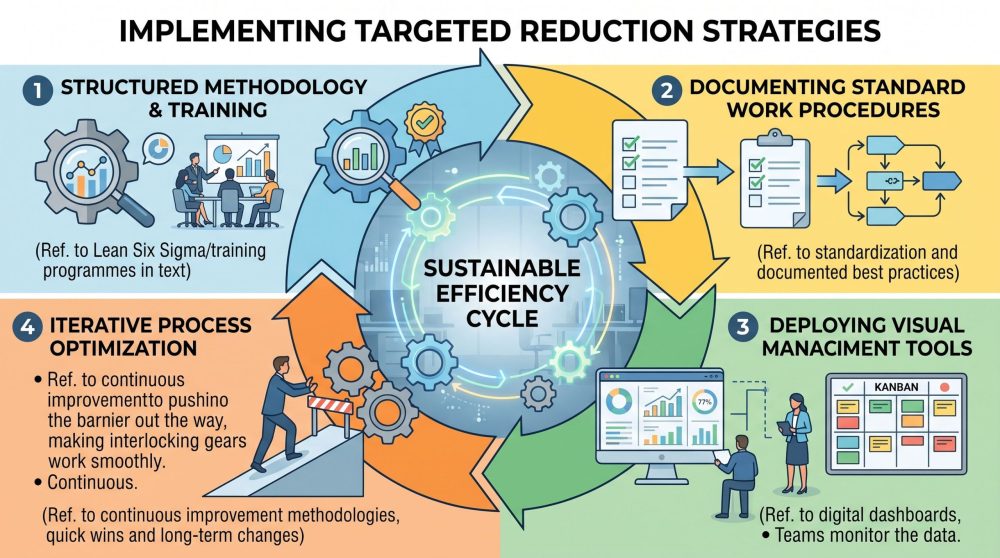
Organizations frequently adopt structured continuous improvement methodologies to guide their waste reduction initiatives.
Structured training programs help internal teams develop the analytical tools needed to sustain these efforts independently.
An overview of how such programmes are structured is available at: theleansixsigmacompany.com/us/group-training.
Standardization is another critical pillar of waste reduction.
When best practices are documented, shared, and consistently followed, process variability decreases significantly.
Standard work procedures provide a stable foundation upon which further optimizations can be built.
Furthermore, introducing visual management tools—such as digital dashboards, Kanban boards, and clearly marked workspace zones—helps teams monitor workflow health in real time, enabling rapid intervention when anomalies arise.
Fostering a culture of continuous improvement
Sustainable waste reduction is not a one-time project but a continuous cultural evolution.
Long-term success depends on leadership commitment, employee empowerment, and psychological safety.
When workers feel encouraged to report inefficiencies and propose innovative solutions without fear of criticism, the organization becomes naturally resilient against complacency and waste.
Regular audits, ongoing educational initiatives, and transparent performance metrics ensure that the insights gained during initial waste-reduction cycles remain embedded in daily operations.
Ultimately, identifying and minimizing operational waste transforms how a business functions.
By removing friction from processes, companies enhance their responsiveness, improve customer satisfaction, and optimize resource allocation.
Embracing this disciplined approach to operational excellence positions any organization for sustained growth and adaptability in a dynamic marketplace.
Analyzing financial impact and resource drain
Uncovering systemic friction requires translating physical delays and excess output into monetary metrics.
When assets sit idle or materials sit unused, the balance sheet suffers from tied-up capital and depreciating value.
Organizations often underestimate the cumulative cost of minor procedural bottlenecks until they evaluate total overhead expansion.
Calculating the true cost involves tracking labor hours spent on redundant checks, storage expenses for excess inventory, and opportunity costs lost during operational downtime.
This financial evaluation provides the objective justification needed to prioritize remediation efforts across departments.
- Quantifying direct material loss and scrap rates.
- Evaluating labor hours diverted to rework.
- Assessing storage and maintenance expenses for excess stock.
- Measuring customer churn resulting from delayed delivery times.
Leveraging technology for real-time anomaly detection
Modern operational frameworks rely on automated monitoring systems to instantly flag deviations from standard operating procedures.
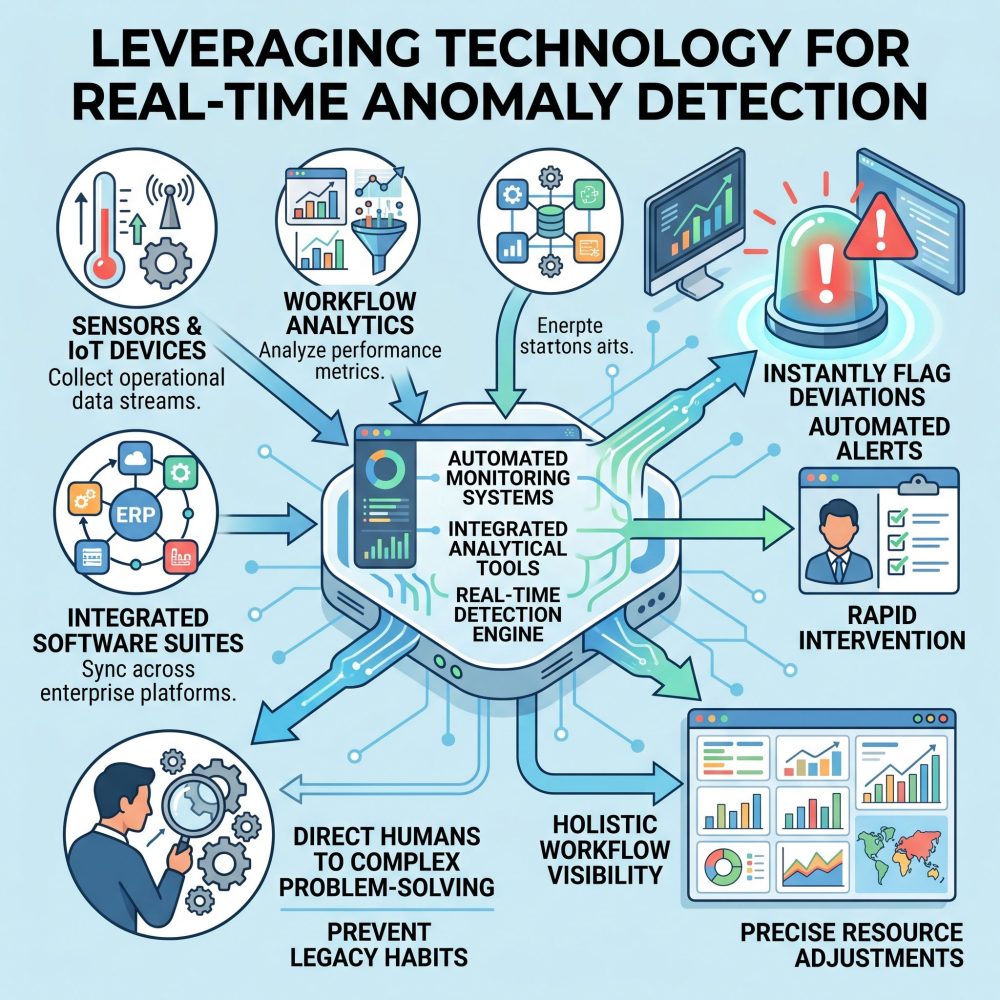
By deploying sensors, workflow analytics, and integrated software suites, teams can observe performance metrics as events occur rather than waiting for weekly or monthly audits.
This immediate visibility allows supervisors to intercept mechanical failures, software glitches, and throughput drops before they escalate into widespread disruptions.
Automated alerts ensure that human oversight is directed exclusively toward complex problem-solving rather than routine surveillance.
Integrating these analytical tools requires a stable infrastructure and clear data governance protocols.
When information flows freely across enterprise resource platforms, leaders gain a holistic view of workflow efficiency, enabling precise adjustments to resource allocation and scheduling.
Establishing long-term governance and accountability
Sustaining efficiency gains demands formalized oversight structures that prevent legacy habits from creeping back into daily routines.
Establishing clear ownership for every workflow ensures that procedural standards are continuously monitored, evaluated, and updated in response to shifting market demands.
Regular reviews led by designated process owners help maintain alignment between strategic goals and frontline execution.
These designated leaders conduct periodic health checks, review performance dashboards, and coordinate cross-functional adjustments when new friction points emerge.
Reward systems and performance metrics must also align with these governance models, encouraging teams to proactively report inefficiencies rather than concealing them.
When transparent communication is incentivized, organizational resilience increases organically over time.
